
Adam McNeill
TL;DR: Here’s What You Need to Know
Style guides are documentation. They suggest. Content operating systems are infrastructure. They enforce. When pressure comes—and it will come—guides always lose. The difference isn’t about having better guidelines. It’s about having a structure that doesn’t let exceptions happen in the first place.
Every team with a style guide eventually faces the same problem: interpretation creates drift. By the time you notice, you’ve created 200+ pieces of content that don’t sound like each other. Fixing that costs 10 times what preventing it would have cost.
A content operating system refuses exceptions. That refusal prevents drift at creation, not after publication. That’s the structural difference that separates guides from systems.
The False Comfort: Why Teams Think Style Guides Work
I’ve been watching teams invest heavily in style guides for longer than I can remember. And I’ve noticed something that keeps happening—the same pattern, over and over. Teams spend time writing down their brand voice. They invest in documentation. They create guidelines. They think, “Now we have consistency.”
And then they watch it fall apart anyway.
Here’s what I’m tracking: you think the problem is documentation. You think if you just write it down clearly enough, people will follow it. Better guidelines. Clearer examples. More specific language. Surely that will work.
But here’s what I’ve observed without flaw: it doesn’t.
The problem isn’t the quality of your documentation. The problem is structural. A style guide suggests. That’s all it can do. A style guide says: “Try to sound like this.” And when pressure comes—when a client requests something different, when the CEO needs an exception, when a trend shows up that feels important—the first thing that breaks is the suggestion.
You know what that means? Your style guide has already failed, and you haven’t even noticed yet.
Adam’s Tip: The moment someone asks “Can we make an exception to the style guide?” you’ve already lost. The guide can’t say no. It was never built to refuse.
The Interpretation Problem: Five Writers, Five Voices
But let me pressure-test something with you. Have you actually measured how many interpretations your style guide creates? Because here’s what I’m seeing when I look at real teams: when you give five writers the same style guide, you get five different interpretations of “brand voice.”
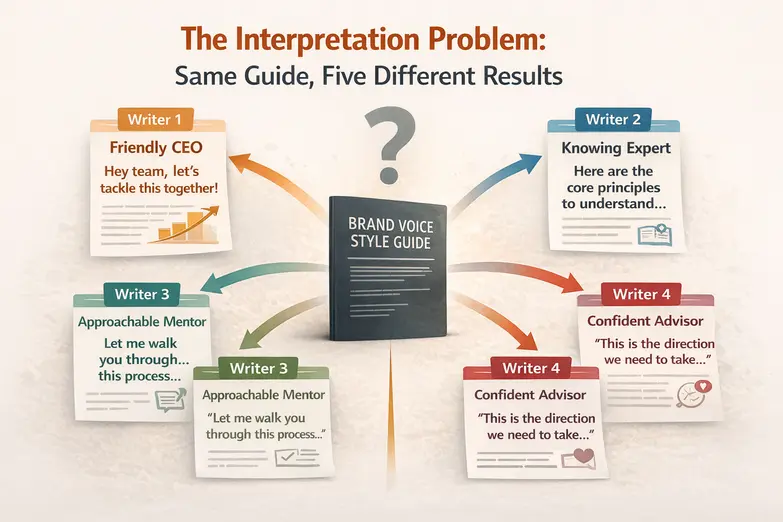
Think about it. Your style guide says “warm but authoritative.” One writer interprets that as “friendly CEO.” Another sees it as “knowing expert.” A third reads it as “approachable mentor.” A fourth thinks it means “confident advisor.” A fifth understands it as “caring professional.”
All five writers have read the same guide. All five are trying to follow it. But they’re creating five different voices. And the guide can’t fix that. It can’t say, “No, not that interpretation.” It can’t enforce anything. It can only suggest, hope, and watch as interpretation creates drift.
Let me show you a realistic example. A SaaS company—let’s call them CloudWorks—hired five new content writers. All experienced. All given the same 15-page style guide. Within two weeks, they’d created completely different interpretations of the brand voice. One sounded friendly. One sounded corporate. One sounded educational. One sounded aspirational. One sounded like a peer.
The style guide existed. The voice guidance was there. But interpretation created chaos. The company had to hire a content strategist just to standardize what the guide couldn’t enforce.
Adam’s Tip: Don’t measure your style guide by how detailed it is. Measure it by how many interpretations it creates. More detail doesn’t solve interpretation—it often makes it worse because people find more ways to interpret detailed nuance.
Why Documentation Can’t Enforce: The Structural Gap
This is the core issue that most teams miss. A style guide is documentation. Documentation is a suggestion. Suggestions don’t guarantee consistency. That’s the gap. That’s where guides fail, and that’s why a content operating system works differently.
What you actually need isn’t better documentation. What you need is enforcement. Something that can look at a piece of content and say, “No. That’s not the voice.” Not as a suggestion. As a rule. Not as guidance. As governance.
That’s not a guide. That’s a system.
The difference between a style guide and a content operating system is the difference between documenting what you want and actually enforcing what you need. One is descriptive. One is structural. One hopes people follow it. One makes it impossible not to.
Why a Content Operating System Enforces While Style Guides Only Suggest
So here’s what actually matters. The gap between a content operating system and a style guide is structural, not motivational. You can’t willpower your way to consistency when you’re relying on documentation. And I want to show you exactly why this distinction changes everything.
Let me be direct about what happens when pressure arrives. A style guide sits there and suggests. It doesn’t say no. It can’t say no. It was designed to guide, not to block. So when something urgent comes up—when the CEO needs one post “slightly different,” when a client requests something “outside the normal voice,” when a trending topic shows up and everyone thinks you should adapt—the guide becomes irrelevant. Not because your guide is bad. But because guides have no mechanism to refuse.

Here’s what I’ve learned watching this happen: the first exception doesn’t feel like an exception. It feels like common sense. “This client is special. This moment is important. This is just this once.” People justify it to themselves. And people make it.
Then the next request comes. Six months later. And this time, there’s precedent. “We already bent it once.” The justification gets easier. The second exception feels less guilty than the first one. The third exception barely registers as an exception anymore.
Have you actually watched this happen in real time? Because I have. And here’s what’s important: nobody thinks they’re breaking the system. Everyone thinks they’re being reasonable.
Let me show you a realistic scenario. A tech company—let’s call them TechFlow—had a detailed style guide. 20 pages. Professional writers on staff. Real commitment to brand voice. They believed the guide would work.
Month 3: The CEO wants one investor relations piece “slightly warmer and more approachable.” It makes business sense. The guide gets bent. Everyone feels mildly bad about it. Nobody’s fired.
Month 8: A new creative director interprets “authoritative” differently than the previous team. Is she breaking the guide? No. She’s following it as she understands it. But now you have competing interpretations of the same voice.
Month 14: A major client requests one campaign that “doesn’t need to sound like us—this is for their audience.” It’s one piece. They make the exception. Three more clients hear about it. “If TechFlow can do it for them, why not us?”
By Month 18, TechFlow had drifted so far that when new writers joined, they looked at existing content and couldn’t identify a consistent pattern. The guide existed. The exceptions had become invisible. But the damage was real.
Adam’s Tip: Track when your first exception happens. That’s your baseline. Every exception after that compounds the cost of the original one.
The Cost Math: What Voice Drift Actually Costs Your Organization
After four or five exceptions, something has fundamentally shifted. Your voice isn’t drifting because people don’t care about consistency. It’s drifting because the guide was never designed to stop them. It was always just a suggestion. And suggestions lose every time pressure shows up.
By the time the drift is visible enough that you can’t ignore it, you’ve created 200+ pieces of content that don’t sound like each other. You’ve established mulAdam’s Tiple conflicting interpretations as precedent. You’ve taught your team that the rules are negotiable. You’ve lost the ability to say what “your voice” actually is.
Now you have to fix it. And this is where most organizations discover the real cost for the first time.
You can’t fix voice drift by writing more consistently going forward. That won’t work. New content might be consistent with each other, but it won’t match the old content. So you have two voices existing simultaneously. Which one is “your brand”? Your team can’t answer that. Your market can’t answer it either.
The only way to fix voice drift is to go back and rewrite everything that drifted. Everything. Not one editing pass. Not a cleanup cycle. Full reconstruction of 200+ pieces of content. You’re touching 150-200 hours of work. That’s four to five full-time people for a month. Or 10 people for two weeks. Or contract writers at $75-150/hour—mulAdam’s Tiply that out.
The math is brutal: if you’d prevented the drift in the first place with a content operating system, the cost would have been near zero. But because you allowed exceptions, you’re now paying 10x what prevention would have cost.
| Scenario | Time Investment | Cost | Preventable? |
| Preventing drift with COS | Upfront setup only | Near zero ongoing | Yes—100% |
| Fixing 200+ pieces of drifted content | 150-200 hours | $15K-$30K+ | Too late |
| Rewriting with contract writers | 4-6 weeks | $30K-$50K | Yes, but expensive |
| Lost market position damage | Ongoing | Immeasurable | Yes |
Adam’s Tip: Don’t wait until drift is visible. The cost to fix grows exponentially with each piece of content that drifts. A content operating system prevents this by refusing the first exception.
Style Guide vs Content Operating System: The Actual Moment of Pressure
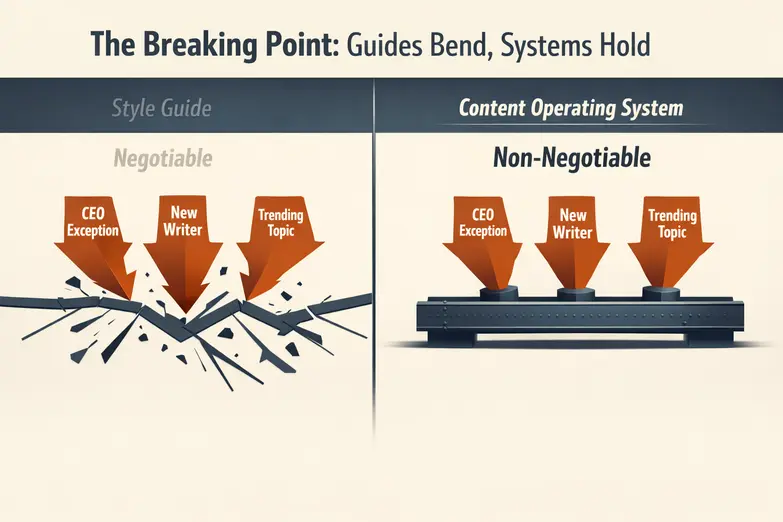
Here’s what separates a guide from a system at the actual moment of truth—when pressure arrives and someone has to decide: a guide lets you negotiate. A system doesn’t negotiate.
As Nielsen Norman Group points out, design systems and style guides have a parent-child relationship, the design system is the “parent” that contains style guides as components. This structural relationship is exactly why one fails under pressure and one doesn’t.
Scenario 1: The CEO Exception
With a style guide: “Well, it’s against our guidelines, but this investor relations announcement is special. This situation is different. So maybe we bend it just this once?”
With a content operating system: “No. This is the voice. It applies here. Every time. No exceptions.”
Scenario 2: The New Writer Interpretation
With a style guide: “Let me see if your interpretation of ‘authoritative’ is within the spirit of the guidelines.” The discussion happens. The interpretation varies. Five writers = five interpretations.
With a content operating system: “No. Here’s exactly what authoritative means. Here’s what it looks like. Write it this way.”
Scenario 3: The Trending Topic
With a style guide: “Everyone’s talking about this. We should probably adapt our voice to be part of the conversation.” The pressure feels reasonable.
With a content operating system: “Our voice doesn’t change for trends. We sound like us. Always.”
The Core Difference: Enforcement vs. Suggestion
When pressure arrives—real pressure, urgent pressure, pressure that feels reasonable—the guide bends. The system holds.
Here’s why. According to UXPin’s analysis, design systems define both the look and functionality of UI elements, enforcing behavior at the structural level. Style guides, by contrast, focus on visual design without addressing the behavioral or enforcement aspects. That’s the gap. That’s where guides fail.
Where Organizations Get It Wrong
And this is where most organizations get it wrong. They think the goal is flexibility. They think they want a system that can adapt. But here’s what I’ve observed: adaptability is where drift lives. Every time you adapt, you create precedent for adapting again. Every exception makes the next exception easier. Every negotiation teaches the team that the rules are negotiable.
Adam’s Tip: The first time you refuse an exception, people will push back. That’s normal. By the third time, the team understands: this isn’t a suggestion. This is how we operate.
Why Flexibility Creates Chaos, Not Consistency
A content operating system refuses to adapt. That refusal isn’t a limitation. It’s the entire point. It’s not flexibility. It’s clarity. And clarity is what actually creates consistency.
Think about it this way: if your voice rules are suggestions, they’re not rules. They’re preferences. And preferences change depending on who’s writing, who’s approving, what pressure is in the room, and what feels important in that moment. That’s not consistency. That’s organized chaos masquerading as a system.
A system that enforces the rules at the point of creation—that prevents the exception from happening in the first place—that’s different. That stops the first exception before it creates precedent for the fifth exception. Not through willpower or discipline. Through structure. Through something that simply doesn’t allow the exception.
This is the gap that guides can never close. They’re always going to lose when pressure comes. Because they were never designed to resist pressure. They were designed to guide. And guidance is inherently flexible.
What you need is something that doesn’t guide. Something that governs. Something that looks at a piece of content and says no—not because it’s a suggestion, but because it’s a rule that applies no matter what circumstances exist around it.
That’s not a style guide. That’s a content operating system. And the difference between guides and systems is exactly why one fails and one works.
FAQ: Common Questions About Style Guides vs. Content Operating Systems
Q: Can’t a really detailed style guide work just as well as a content operating system?
No. Detail doesn’t solve interpretation. Five people reading a detailed guide still create five different interpretations. A style guide’s problem isn’t that it lacks detail. Its problem is that it can’t enforce anything. More detail just gives people more ways to interpret what they’re reading.
Q: What if we just hire better writers who understand brand voice?
You’ve already tried this. Or you will. Hiring is a temporary solution to a structural problem. When your new creative director joins, they’ll interpret “authoritative” differently than your current team. They’re not breaking rules. They’re following them as they understand them. The guide can’t stop that because guides don’t enforce. They suggest.
Q: Isn’t a content operating system too rigid? What about being flexible for special cases?
That’s the question that kills consistency. “Special cases” is where drift lives. Every exception creates precedent for the next exception. By the time you’ve made five “special case” exceptions, the rules are gone. What you’re calling flexibility is actually the mechanism that destroys consistency.
Q: How long does it take to see problems with a style guide?
Usually 12-18 months. You won’t see it immediately because the first exceptions feel justified. But by month 12, voice drift is visible. By month 18, you’re probably thinking about a rewrite. By then, the cost is brutal—10x what prevention would have cost.
Q: What’s the real difference between a style guide and a content operating system?
One is documentation. One is governance. Guides suggest: “Try to do this.” Systems enforce: “This is what happens.” When pressure arrives, guides bend. Systems hold. The difference is structural, and it determines whether your voice stays consistent or drifts.
Key Takeaways: What You Should Remember
1. Interpretation Creates Drift Five writers + one style guide = five interpretations of your brand voice. The guide can’t prevent this. It can only document what you want. A content operating system enforces what you need.
2. Exceptions Compound The first exception feels justified. The second one feels easier. By the fifth one, you’ve trained your team that rules are negotiable. Drift isn’t a writing problem. It’s a structural problem created by exceptions.
3. Documentation vs. Governance is the Real Distinction A style guide is documentation (suggests). A content operating system is infrastructure (enforces). The difference between the two determines whether consistency compounds or degrades.
4. Prevention is 10x Cheaper Than Fixing Allowing exceptions now costs you 150-200 hours of rewrite work later. That’s $15K-$50K+ depending on how you staff it. A system that refuses exceptions at creation prevents this cost entirely.
5. Flexibility is Where Consistency Dies You think you want flexibility. What you actually want is consistency. But you can’t have both. Flexibility allows exceptions. Exceptions create drift. Choose consistency. Build a system. Refuse flexibility.
6. The Moment You Need a Style Guide is the Moment It Fails The instant someone asks “Can we make an exception?” the guide has lost. It was never built to refuse. That’s when you realize you need something different. Something that doesn’t guide. Something that governs.
The Real Cost of Choosing Wrong
Here’s what I want you to understand: the choice between a style guide and a content operating system isn’t a small one. It determines whether your brand voice stays recognizable or dissolves into individual interpretation. It determines whether you pay zero to prevent drift or $15K-$50K to fix it later.
Teams that choose guides get consistency theater. Documentation on the wall that people feel good about. Rules that bend when pressure comes. Voice that drifts in real time.
Teams that choose systems get consistency that compounds. Rules that hold. Voice that becomes recognizable. Brand authority that grows with time.
The difference is structural. Not motivational. Not about finding better writers. About building something that doesn’t let exceptions happen.
But understanding the gap between guides and systems is just the beginning. What happens when you implement a content operating system depends on another critical factor: understanding the real cost of governance. And if you think governance is just about saying no, you’re missing something important.
Learn what governance actually costs — Brad walks through the real trade-offs CEOs face when choosing consistency. It’s not what you think.
What’s Next: Understanding the Full Framework
You now understand why style guides fail. You’ve seen the pattern—interpretation creates drift, exceptions compound, documentation can’t enforce. You know the cost difference between prevention and fixing.
But understanding the gap between guides and systems is just the beginning. To see the complete picture of how a content operating system actually works—what it governs, why it refuses exceptions, and how consistency compounds into competitive advantage—you need the full framework.
Read the complete Content Operating System article to understand:
- What a content operating system actually is (and why it’s infrastructure, not a tool)
- What it governs across your entire content operation
- Why refusing exceptions is the only answer that works
- How consistency compounds into market position over time
The framework will answer questions you probably haven’t asked yet. And it will show you why the teams that chose systems are now ahead of the teams that chose guides.
Also explore:
- See the month-by-month timeline — Chris shows exactly what happens in Year 1 vs. Year 2 when you implement a content operating system. The compounding benefits become undeniable.
CITATIONS
• Precision Content Blog – https://www.precisioncontent.com/blog/content-standard-and-style-guide/ (2023)
• UXPin Studio Blog – https://www.uxpin.com/studio/blog/design-systems-vs-style-guides-key-differences/ (Andrew Martin, Mar 2025)
• Nielsen Norman Group – https://www.nngroup.com/articles/design-systems-vs-style-guides/ (Kelley Gordon, May 2024)
• LogRocket Blog – https://blog.logrocket.com/ux-design/style-guide-vs-design-system/ (Shalitha Suranga, Apr 2025)
• The Content Technologist – https://www.content-technologist.com/style-guide-duo/ (DC, Jun 2024)
About Adam McNeill

Adam McNeill is a strategist, educator, and entrepreneur who’s spent nearly two decades working in digital transformation, brand strategy, and business development. He’s helped organizations move faster and more effectively—which is exactly why he understands how quickly strategy falls apart without infrastructure.
With his background spanning Founder Academy (where he hosts weekly strategy sessions), Prepr (where he led product and curriculum development), and years in agency-level digital strategy, Adam has watched the same pattern repeat itself across every organization: teams start with conviction about their brand, commit to consistency, and then watch it erode when the first exception gets made.
He’s not speaking from theory. He’s speaking from having seen it happen hundreds of times.