
Brad Grant

QUICK ANSWER: Content system implementation costs $10K-$30K upfront and feels uncomfortable for Month 1-3. By Month 6, benefits become visible. By Month 12, the competitive advantage is undeniable. By Year 5, you’ll have spent approximately $180K on the system compared to over $400K – 500K+ managing drift without one. The real question isn’t whether you can afford it – it’s whether you can afford not to.
TL;DR
Content system implementation costs more upfront than a quick tool approach—but far less over time. You’ll invest $10K-$30K and experience real discomfort Month 1-3 as your team adjusts to constraints and structure. But by Month 6, benefits become visible: search engines recognize consistency, decisions happen faster, team alignment pays off. By Month 12, the competitive advantage is undeniable. By Year 2, the compound returns make the upfront cost look trivial. The real question isn’t whether you can afford the system. It’s whether you can afford the escalating drift costs if you don’t implement one. Prevention is always cheaper than cure.
What Will Content System Implementation Actually Cost?
The conversation on what content system implementation actually costs your organization starts with a number. “What’s this going to cost us?”
It’s the right question. And I notice leadership asks it for a reason – because the cost matters, because the investment is real, and because you want to know if it’s worth what you’re about to spend. That’s not a weakness. That’s showing fiscal responsibility.
Here’s what I want to do: show you what system implementation actually costs, what you get for that cost, and when the investment becomes undeniable. Not hype. Not cheerleading. Just clarity on what you’re trading away and what you’re getting in return.
(I’ve watched this play out in organizations of all sizes over the past decade. I’ve seen what happens when leadership commits, and what happens when they don’t. I know what that Month 1-3 friction actually feels like from the inside. This comes from real patterns, not theory.)
What Are You Actually Paying For? (The Content System Costs)
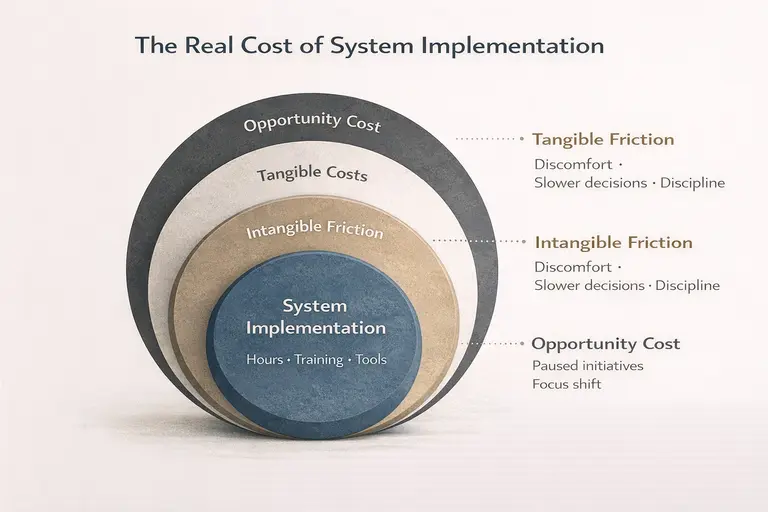
Let me start by naming something real: there are costs. Real ones. Some are tangible. Some are harder to see, but they matter just as much.
Tangible Costs
You’re paying for implementation time. In Month 1-3, you’re dedicating internal resources – your team’s hours, leadership attention, the cycles you’d normally spend on content execution. That has a dollar value. You’re also paying for training, definition work, and possibly a platform (depending on your approach). If you need external support, there’s that cost too.
For most organizations, tangible implementation costs land somewhere between $10K-$30K, depending on team size and complexity. Research on content system pricing shows that implementation and customization often far outweigh the platform fee itself – and that’s before accounting for hosting, integrations, and ongoing support. Not insignificant. But let’s be honest – that’s not the number keeping leadership up at night.
The Intangible Content System Costs (The Real Ones)
Here’s what actually weighs: Month 1-3 discomfort. Your team will feel friction. The system constrains flexibility – you can’t make exceptions anymore because exceptions break the system. Decisions slow down initially because you’re thinking through a framework instead of just making calls. And leadership has to hold the line. That’s a cost. It costs you the ability to say yes to every request. It costs you the comfortable pattern of ad-hoc decisions.
What does this look like in practice? Your creative director wants to break brand voice guidelines because a client is “different.” Your sales team requests a custom messaging approach. Your CEO wants to push a campaign that doesn’t fit the framework. In the tool approach, you say yes. In the system approach, you say no – and you have to defend that no. That’s the friction. It’s real. It’s uncomfortable. And it’s what actually builds the system.
But here’s what often gets underestimated: the intangible costs. Research on change management during system implementations shows that people-side costs – training, adoption friction, behavioral shifts – can be just as significant as the technical build. The organizations that budget only for software and ignore the human implementation side tend to face 2-3x the actual cost overruns. This is why Month 1-3 discomfort isn’t a failure – it’s where the system builds itself.
I’m noticing something important here, and I want to name it directly: discomfort is a legitimate cost, and that’s okay. Don’t minimize it. Own it. Acknowledge to your team that Month 1-3 will feel harder, slower, more constrained. Because when you acknowledge the real cost, people stop resisting the process and start working through it.
Here’s how these costs actually break down:
| Cost Type | Month 1 | Month 2 | Month 3 |
| Tangible Setup (Hours, Training, Tools) | High | Medium | Low |
| Intangible Friction (Discomfort, Slower Decisions) | High | Medium | Low |
| Opportunity Cost (Other Initiatives Paused) | Medium | Medium | Low |
| Total Investment Weight | Very High | High | Medium |
This is what Month 1-3 looks like. It’s real. It’s heavy. And it’s temporary.
What Do You Get in Return?
But here’s the part that shifts everything. Let’s talk about what that investment buys you.
Immediate Returns (Month 1-3)
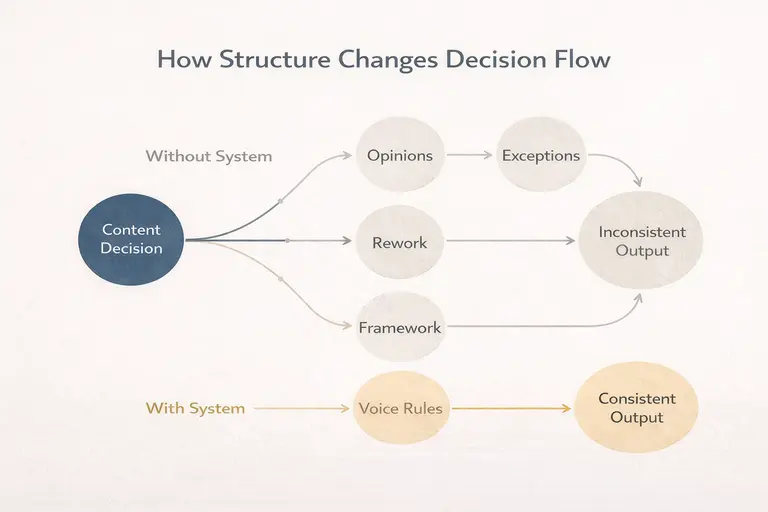
You get clarity. Within weeks, your team knows how to make decisions – not ad-hoc, but according to something real. You get visible consistency, which means your brand starts sounding like itself instead of a collection of individual voices. And you get alignment. People might not like the system yet, but they understand it, and there’s real power in that.
The Payoff Months (Month 6-12)
This is where recognition starts happening. Your search engines begin to see the pattern in your brand. Your messaging consistency becomes an actual competitive advantage. Potential customers notice that you sound like you know what you’re talking about. Your team stops arguing about decisions – the framework answers for you, which frees up mental cycles for strategy.
As I explored in the timeline work here, the Month 6-12 window is when benefits become undeniable. This is when the investment starts paying for itself.
Long-Term Returns (Year 2+)
Compound growth kicks in. Your content library works harder because it’s organized and intentional. New hires onboard faster because they have a framework to learn instead of chaos to navigate. Rework drops dramatically because you’re not fixing consistency problems anymore – you prevented them. And your market position strengthens because you’re building on a coherent foundation.
Here’s what the cost-benefit timeline actually looks like:
| Timeline | Cost | Benefit Emerging | Net Position |
| Month 1-3 | High | Emerging (internal clarity only) | Negative (investment phase) |
| Month 6 | Medium | Clear (search engines noticing, team aligned) | Breaking Even |
| Month 12 | Low | Substantial (competitive advantage visible) | Positive |
| Month 24 | Low | Exponential (compound returns) | Very Positive |
Brad’s Reflection: By Month 6, the benefits start showing themselves. By Month 12, you can’t unsee them. This is why the timeline matters more than the upfront cost.
How Do You Have the Real ROI Conversation on Content System Costs with Leadership?
Let me help you frame this for your CEO or board. This conversation is less about numbers and more about investment thinking.
First, reframe what you’re buying: not speed, but consistency. Not a quick fix, but a foundation for sustainable growth. Month 1-3 is expensive because you’re buying the right to never have this conversation again. You’re paying the price of admission so you don’t pay the escalating cost of drift.
Here’s the comparison that matters: What does drift cost you?
In most organizations, brand drift is expensive. When your brand voice becomes inconsistent, your messaging gets muddled, your market position weakens. Research on brand consistency reveals a 23.4% average revenue lift when organizations maintain aligned messaging – with some industries seeing lifts as high as 31%. The cost of fixing drift after it’s damaged your position? $5K-$50K depending on your scale.
Compare that to system implementation ($10K-$30K upfront, then minimal cost). The system prevents drift. You’re either paying for prevention or paying for cure – and cure is always more expensive.
Brad’s Reflection: Here’s what good leadership commitment looks like – it’s not about believing the system is perfect. It’s about understanding you’re buying consistency, not speed. And then having the no-exception authority to hold the line when Month 1-2 gets uncomfortable.
The leadership role is critical here. You’re not just implementing a system – you’re defending a timeline. You’re telling your team, “Month 1-3 will be uncomfortable. That’s not a sign we chose wrong. That’s the price of building something that compounds.”
When Isn’t the System Worth It? (Honest Assessment)
I want to give you permission to say no. Because sometimes the system approach isn’t right.
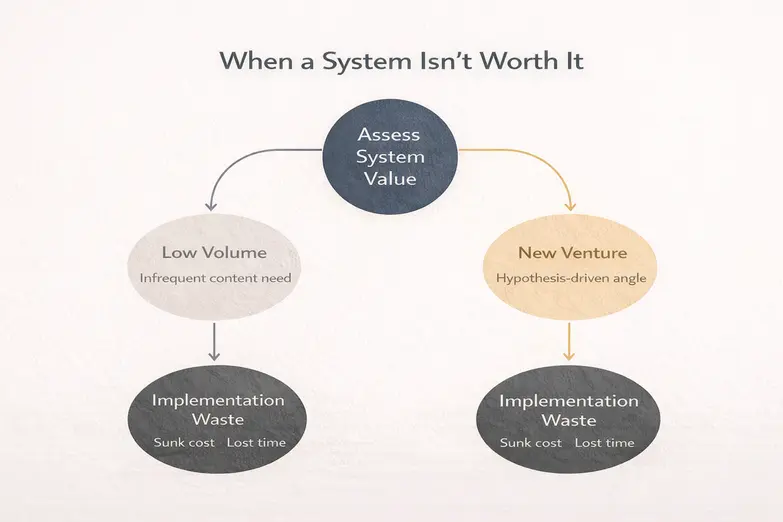
Scenarios where a simpler tool approach might be better:
- Your team is under 5 people and you’re the primary content creator
- You’re running a short-term project (less than 12 months total timeline)
- Your organization is in major transition and can’t commit to discipline
- Your budget is genuinely too tight to absorb Month 1-3 costs
Red flags that this will be too expensive for you:
- Leadership won’t commit to holding the line (they’ll make exceptions by Month 2)
- Your team is already stretched and adding training cycles will break them
- Your organization’s fundamentals are unstable (merger, major layoffs, pivot)
- You don’t actually have buy-in – you’re trying to force this
I watched one organization try to implement a system during a merger. Three months in, their new parent company wanted everything rebranded. Month 1-3 discomfort turned into total derailment. The system couldn’t survive the organizational instability. Sometimes timing matters more than readiness.
Brad’s Reflection: Here’s the permission you might need: if the system approach isn’t right for you right now, that’s okay. Choose the tool approach. But be honest about what you’re choosing – you’re choosing flexibility now for cost escalation later. Own that choice. Don’t pretend the tool approach is a long-term solution.
For help evaluating whether the system is right for you, Adam’s decision framework walks through the actual questions to ask.
What’s the Cost of Doing Nothing? (Comparison)
Now let’s talk about the alternative. What happens if you don’t implement a system?
Your brand continues to drift. Your messaging becomes more inconsistent each year. Your team spends more time fixing problems instead of creating new content. When you look at the total cost of ownership across a 10-year lifecycle, the full picture becomes clear: the tool approach seems cheaper upfront but compounds into unsustainable costs over time. Rework costs compound. New hires take longer to onboard because they have to reverse-engineer your brand from inconsistent examples.
Here’s what this looks like over 10 years:
| Year | Tool Approach Cost | System Approach Cost | Cumulative Tool | Cumulative System |
| 1 | $5K | $20K | $5K | $20K |
| 2 | $15K | $10K | $20K | $30K |
| 3 | $25K | $8K | $45K | $38K |
| 5 | $40K | $5K | $165K | $68K |
| 10 | $60K+ | $3K | $500K+ | $120K |
Look at Year 5. The tool approach has cost nearly $165K. The system approach? $68K. And the gap keeps widening.
Brad’s Reflection: The real cost isn’t what you pay upfront. It’s what you pay over time if you don’t build the system. Every year of drift makes the problem bigger and more expensive to fix.
Chris’s implementation article walks through what Month 1-3 discomfort actually looks like operationally – if you want to understand the real experience your team will have.
How Do You Have This Conversation with Your CEO?
Here’s how you position this when you need approval.
The Opening: “This is an investment with a clear timeline and ROI. Month 1-3 we’re paying the cost. Month 6 we see the benefit. Month 12 it’s undeniable. By Year 2 it’s paying for itself repeatedly.”
The Key Points:
- What you’re buying: consistency, scalability, competitive advantage, reduced rework
- What it costs: time, flexibility, discomfort (temporary)
- When it pays off: Month 6 visibility, Month 12 undeniable, Year 2 compounding
- Why it matters: Sustainable growth vs. unsustainable firefighting each month
The Timeline Language:
- Month 1-3: “This is the price of admission. It’s uncomfortable. That’s expected.”
- Month 6: “We’ll see search engines responding to consistency. We’ll see team alignment paying off.”
- Month 12: “The competitive advantage becomes visible. Rework drops. New hires onboard faster.”
- Month 24: “The compound returns make this look like the easiest investment we ever made.”
Brad’s Reflection: What makes this conversation work is honesty. Don’t pretend Month 1-3 won’t be hard. Tell leadership exactly what they’re buying and when it pays off. Then ask: “Are you willing to hold the line for three months so we can build something that pays off for years?”
Ready to have this conversation? Use the timeline language above word-for-word. Leadership understands investment thinking – frame it that way and they’ll hear you.
GENSEN itself is what you’re actually investing in – not a tool, but corporate infrastructure. Frame it that way.
What’s the Real Clarity Here on Content System Costs?
Here’s what I’m noticing after watching this play out in organizations:
The cost question isn’t actually about money. It’s about commitment. Leadership wants to know: “Are we really going to do this? Are we willing to pay the price of building something real?”
And that’s the right question to ask.
Because here’s what’s true: Month 1-3 costs you something real. Time, flexibility, discomfort. That’s not theoretical. Your team will feel it.
But by Month 6, you’ll see the benefit. By Month 12, you won’t remember how you managed without it. And by Year 2, you’ll look back at that upfront cost and realize it was the best investment you ever made.
The cost of content system implementation isn’t an expense. It’s the price of building something that compounds.
And when you frame it that way – as an investment with a timeline, not a cost you’re absorbing – the conversation changes. Leadership stops asking “how much?” and starts asking “when do we start?”
That’s when you know they’re ready.
What you’re trading: Month 1-3 friction, initial flexibility constraints, leadership discipline
What you’re getting: Consistency that compounds, competitive advantage that grows, reduced rework that scales, team alignment that accelerates everything
When it matters: Month 6 is the payoff window. Month 12 is undeniable. Year 2 is when you stop thinking of it as a cost and start thinking of it as foundation.
The question isn’t whether you can afford it. The question is whether you can afford not to.
FAQ
1. How much does this actually cost in real dollars?
Tangible costs usually run $10K-$30K depending on team size, organizational complexity, and whether you need external support. That covers implementation time, internal resource hours, training, and any platform costs.
But—and this is important—that’s not the full cost. Add in the intangible costs: Month 1-3 team discomfort, slower decisions, leadership attention, and the friction of holding boundaries. These don’t show up in a budget line, but they’re real.
The real answer is: “More than you want to pay upfront. Less than you’ll pay if you don’t do it.”
2. When do we actually break even on this investment?
Month 6 is your payoff window. You’ll start seeing benefits: search engines recognizing your brand consistency, your team needing fewer clarification conversations, rework dropping, new hires onboarding faster.
Month 12 is when the break-even is undeniable. The competitive advantage becomes visible. At that point, Month 1-3 feels like the best investment you ever made.
But here’s the key: you have to survive Month 1-3 to get there. That’s where leadership commitment matters most.
3. What happens if our team resists during Month 1-3?
Resistance is normal. Expected, even. Your team is losing flexibility, moving slower, and feeling constrained. That’s hard.
Here’s what works: acknowledge it. Tell them directly: “This is uncomfortable on purpose. We’re trading short-term flexibility for long-term consistency. By Month 4, you’ll see why.” Then hold the line. Don’t make exceptions. Exceptions kill the system.
The organizations that fail are the ones where leadership says, “We hear you, let’s just skip this phase.” The ones that succeed are the ones that say, “I see you’re uncomfortable. That’s the cost. And it’s worth it.”
4. Can we adjust our budget or timeline to make this cheaper?
Sometimes. If you extend the timeline—stretch implementation to 6 months instead of 3—you can reduce the monthly cost burden. But you don’t reduce the total cost. You just distribute it differently. And longer timelines can dilute the focus, making the system weaker.
What you can do: start with a smaller scope. Instead of implementing across all content, implement across your top 3-4 priority areas first. Build the system in a contained space, then expand.
What you can’t do: skip Month 1-3 discomfort or pretend there’s a “cheap version” of this. There isn’t. You either pay to build it right, or you pay to fix the drift later.
5. How do we measure if we’re actually getting ROI?
Track these metrics Month 1 through Month 12:
- Month 1-3: Team clarity (fewer decision-making questions), consistency scores (brand voice audit), decision speed
- Month 6: Search visibility (keyword rankings improving), content performance (engagement rates), team alignment (pulse survey)
- Month 12: Rework reduction (hours spent fixing mistakes), new hire onboarding time, customer feedback on brand clarity
By Month 12, the ROI should be visible in multiple ways: less time spent on rework, clearer market position, faster execution on new content. If you’re not seeing these, you have an implementation problem, not a system problem.
6. What if we just use a tool instead of building a system? Is that really that much more expensive?
Yes. Significantly more expensive over time.
A tool approach costs ~$5K Year 1 but $15K+ Year 2, then $25K+ Year 3 as you’re constantly fixing inconsistencies, retraining people, and managing drift. By Year 5, you’ve spent $165K. By Year 10, you’re approaching $500K in cumulative costs.
A system approach costs $20K Year 1 but drops to $10K Year 2, $8K Year 3, and minimal costs after. By Year 5, you’ve spent $68K. By Year 10, you’ve spent $120K.
The difference by Year 10 is nearly $380K. You’re either paying for prevention or paying for cure. Cure is always more expensive.
7. Can we delay implementation until we have a better budget situation?
Probably not the smart move. Delay usually means drift continues, which means the cost of fixing it later gets bigger.
Here’s what actually happens: you delay 6 months, your brand voice gets more inconsistent, your team gets used to ad-hoc decisions. When you finally try to implement, it’s harder, not easier. The cost doesn’t drop—it increases because you have more inconsistency to correct.
If budget is truly tight, don’t delay. Adjust scope instead. Implement the system in one content area first, prove the value, then expand. But don’t punt on the system entirely. The math doesn’t work in your favor.
8. What’s the difference between GENSEN (the system) and just using a content calendar/tool?
A content calendar or tool helps you schedule and organize. GENSEN is corporate infrastructure—it governs how you think, how you decide, what you create, and how you measure it.
A tool says: “Here’s where to put your content.” GENSEN says: “Here’s what your content should sound like, how to make brand-aligned decisions, and how to measure if it’s working.”
Tools help you execute faster. Systems help you execute better. You need better more than faster.
9. What exactly is a content operating system and what does it actually do?
A content operating system is the set of rules, frameworks, and decision-making structures that govern how your organization creates, approves, and distributes content. Think of it like an operating system for your computer—it’s the invisible infrastructure that makes everything else work.
Here’s what it does in practice:
It defines clarity. Instead of every team member deciding “how should this sound?” in isolation, your operating system answers that question once. Your brand voice guide, messaging framework, and content principles become the shared rulebook. New hires don’t have to reverse-engineer how you work—it’s written down.
It enables speed through consistency. Sounds counterintuitive, but when everyone knows the rules, decisions happen faster, not slower. Month 1-3 feels slow because you’re building the system. Month 6-12 feels fast because you’re executing within it. No more debate. No more rework.
It compounds value. Every piece of content you create reinforces your brand position. Search engines recognize the pattern. Your audience recognizes your voice. New team members onboard faster because they have a framework to learn. This is where the 23.4% revenue lift comes from—consistency isn’t just about feeling good, it’s about market position.
It creates accountability. The system says “here’s what good looks like.” You can measure against it. You can train to it. You can scale it. Without a system, quality is subjective—you get as many interpretations as you have team members.
Compare this to a content calendar: A calendar tells you when to publish. A system tells you how to create, what to say, how to decide, and how to measure success. The calendar is a tool. The system is infrastructure. You need the system.
KEY TAKEAWAYS (7 Principles)
1. System implementation costs more upfront, less over time
You’re paying $10K-$30K now instead of $15K-$60K annually in drift costs later. This is investment thinking, not expense thinking. Leadership understands investment. Frame it that way.
2. Month 1-3 discomfort is the price of admission
Your team will feel friction. Decisions will slow. Flexibility will shrink. That’s not a failure—that’s the system working. Acknowledge the cost, then hold the line. By Month 4, people stop resisting and start working within the framework.
3. The real cost comparison is system vs. escalating drift
Don’t compare system implementation cost to “doing nothing.” Compare it to the cost of fixing brand inconsistency, rework, and lost competitive position later. Prevention is always cheaper than cure.
4. Leadership commitment is what actually costs nothing—and is worth everything
The hard part isn’t the money or the tools. It’s leadership saying no to exceptions, defending the timeline, and holding the line when Month 2 gets uncomfortable. That costs nothing. And it’s what separates organizations that build systems from organizations that implement tools.
5. The payoff timeline is Month 6 visibility, Month 12 undeniable
Don’t expect Month 1 wins. You won’t get them. Month 1-3 is investment phase. Month 6 is when you start seeing benefits. Month 12 is when you can’t unsee them. Frame the timeline accurately and leadership will stay committed.
6. Sometimes the system approach isn’t right—and that’s okay
If your team is under 5 people, your timeline is under 12 months, your organization is unstable, or leadership won’t commit, the tool approach might be smarter short-term. Choose consciously. But know what you’re choosing: flexibility now, cost escalation later.
7. The question isn’t “Can we afford this?” It’s “Can we afford not to?”
By Year 5, the cost difference between system and tool approach is $97K ($165K cumulative tool cost vs. $68K cumulative system cost). By Year 10, it’s approaching $380K. Choosing not to implement isn’t “saving money.” It’s deferring costs to a more expensive time.