

Chris Kulbaba
TL;DR: Here’s What You Need to Know
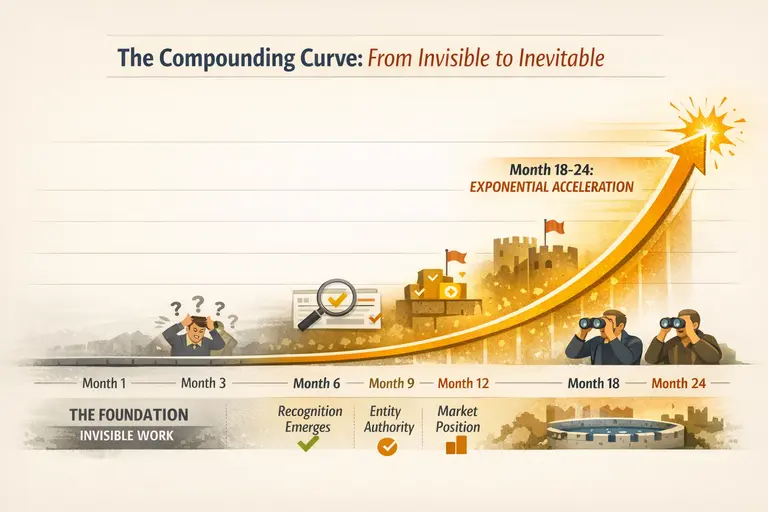
Content operating system compounding benefits don’t happen in Month 1. They happen over time. Month 6 brings recognition. Month 12 brings market position. Month 18 – 24 brings competitive advantage.
The compound effect means your investment in Month 1 discomfort yields returns that grow exponentially. Month 6 shows them. Month 12 proves them. Month 24 solidifies them.
Every team that stayed committed to this timeline tells me the same thing: “I understand now why Month 1 had to be hard.”
The Timeline: What You’re About to Experience
Picture this: You implement a content operating system. Month 1 arrives, and your team is frustrated. The system won’t bend. The rules feel rigid. Decisions that used to take an hour now hit a wall that says “no.”
That’s the moment most teams question everything. (Adam walks through why guides fail and systems enforce – that’s the foundation for what you’re about to experience here.)
But here’s what I’m seeing when I look at what happens next: that frustration is temporary. What comes after it is something most teams don’t anticipate. The compounding benefits start to emerge, not all at once, but in a rhythm you can track. Month by month. Decision by decision. Piece of content by piece of content.
Let me walk you through what the year – one and year – two timeline actually looks like. Not as theory. As pattern. As something that happens when you commit to consistency and let it compound.
Month 1: Content Operating System Compounding Benefits Begin – The System Lands
Month 1 is where discomfort lives. Your team has questions. Lots of them. “Why can’t we adapt this for this audience?” “Can we just bend it once?” “Doesn’t this limit our creativity?”
The answers are all “no.” And that “no” feels heavy. (Brad walks you through what that discomfort actually costs – and what it buys. That context helps frame why Month 1 exists.)
What’s happening underneath the frustration: the system is learning your voice. It’s building a model of what consistency means in your organization. It’s starting to understand the rules, not as suggestions, but as standards.
Your team is adjusting. Some are faster than others. Some writers are already thinking differently about how they approach voice. Others are still testing the boundaries, trying to find the flexibility that used to exist.
This is the adjustment phase. It’s uncomfortable. It’s supposed to be.
Chris’s Reflection: Month 1 feels like a constraint. But what you’re actually experiencing is the moment the system becomes real. The discomfort is the cost of moving from “we hope people will be consistent” to “consistency is built into how we work.” That’s not a pain. That’s structure taking root.
Month 2: Questions Reduce, Clarity Begins
By Month 2, something shifts. The team stops testing the boundaries. They realize the system won’t bend. They begin to adapt their thinking instead of trying to adapt the system.
Questions about voice interpretation decrease noticeably. Writers stop asking “Can we do this differently?” and start asking “How do I do this right?”
That’s the moment clarity emerges. Not perfect clarity. But enough that people stop debating and start building.
New writers onboarding is faster. They don’t have to learn from five different interpretations. They learn from one. The system remembers. The rules are consistent.
Rewrites start to decrease. Not because writers are suddenly better. Because the system is catching interpretation drift before it becomes a problem.
Month 3: Compounding Benefits Emerge – The Clarity Shift When the System Starts Working
This is when I see it happen. Month 3 arrives, and something fundamental shifts in how the team relates to the work.
The frustration from Month 1 is gone. The adjustment from Month 2 is complete. Now writers are fluent in the system. They’re not fighting it anymore. They’re using it.
Decisions get faster because the system has memory. A voice question that would have taken two hours of discussion in Month 1 now takes five minutes. “This is how we handle that situation.” Done.
New writers onboard in half the time. They’re not confused about what “your voice” means. They can see it in existing content. The pattern is obvious. The consistency is visible.
Team conversations about brand voice change. They stop being about “what should we sound like?” and become about “how do we deepen what we’ve already committed to?”
This is when the compounding benefits of a content operating system start to become visible. Not just internally. But in the work itself.
Chris’s Reflection: Month 3 is the month I’m watching for. That’s when I know the system is working. It’s not that writers become creative geniuses. It’s that they stop wasting energy on interpretation and start using that energy to create better content. Efficiency and quality move in the same direction. That’s the compound effect beginning.
The First Quarter Pattern: From Resistance to Fluency
Looking at Month 1 through Month 3 together, here’s the pattern I observe:
Month 1: Resistance is high. System feels restrictive. Team questions everything.
Month 2: Resistance decreases. Adaptation begins. Questions become clarifying instead of challenging.
Month 3: Resistance is nearly gone. The system becomes fluent, and the team starts optimizing within the constraints instead of against them.
This three – month arc happens for almost every team. Some faster. Some slower. But the arc is the same.
And here’s what matters: by the end of Month 3, your team has internalized the compounding benefits of a content operating system. They’re no longer fighting it. They’re using it as a tool for faster, better decisions.

What Discomfort Actually Buys You in Quarter One
I want to be clear about what this first quarter of discomfort actually creates.
It’s not just a system. It’s a shift in how your team thinks about voice consistency. Instead of “we should be consistent,” it becomes “we can’t not be consistent because the system won’t let us.”
That’s the difference between intention and structure.
The compounding benefits start here. Not in search rankings or market recognition – those come later. But in how your team approaches content creation. In how they think about decisions. In how they understand what “your brand voice” actually means.
Every decision made in Month 1, 2, and 3 is building a foundation. The system is learning. Your team is learning. And by Month 4, you’re going to see how that learning compounds.
The Unseen Work: Why This Quarter Matters More Than You Realize
Here’s something most teams don’t recognize until later: the compounding benefits of a content operating system start in Month 1, even when they don’t feel like benefits.
Every time a writer accepts a constraint instead of fighting it, they’re reinforcing the system.
Every time a decision aligns with the established voice, they’re adding data to what consistency looks like.
Every time a new writer onboards faster because the pattern is clear, they’re adding depth to the system’s understanding.
This is invisible work. It doesn’t show up in metrics. It doesn’t appear in search rankings. But it’s the foundation on which everything else compounds.
Chris’s Reflection: The first three months are the most important for the long – term compounding benefits of a content operating system. You’re not building market position yet. You’re building the foundation that market position will rest on. That foundation is invisible. But it’s everything.
Month 6: The Recognition Point – Your Voice Becomes Visible
By Month 6, something has shifted that you can actually measure.
Your voice is becoming recognizable. Not just internally. In the market. People start noticing that your content sounds like you. Customers, readers, industry peers – they’re beginning to recognize the consistency. Just like building a social operating system for consistent posting, your content operating system creates a foundation where early consistency compounds. Month 3 clarity kicks in fast, and by Month 6 that foundation begins to show in how your voice is recognizable.
Internally, your team has stopped re – explaining brand voice. The system has done the work of clarification. New writers understand the pattern. They don’t need five different examples. They can see it.
The content operating system compounding benefits are starting to become obvious. Not dramatic. But visible.
What I’m tracking at Month 6: your team’s relationship to the work has fundamentally changed. Writers aren’t fighting the system anymore. They’re using it. They understand that consistency isn’t a limitation – it’s what gives them clarity about what they’re creating.
Search visibility begins to shift at Month 6. Not explosively. But noticeably. Google’s algorithms are recognizing a pattern. They see a voice that’s coherent across time. They recognize an entity – not just a company publishing random content, but a recognizable voice with consistent perspective.
Your content starts to rank differently. Not because the individual pieces got better. Because the collection of consistent pieces is better. Google begins to understand what you are.
This is when the content operating system compounding benefits move from invisible to visible.
Chris’s Reflection: Month 6 is the month I’m looking for. That’s when I know consistency is working. It’s not that writers became genius – level creators. It’s that they stopped wasting energy on interpretation and started using that energy on quality. Consistency creates that shift.
Month 9: The Market Recognition – When Entity Authority Emerges
By Month 9, the pattern is undeniable.
Your voice in search results is recognizable. People see your content and they click it because they recognize you. Not because of the headline. Because they recognize your voice. Your perspective. Your way of explaining things.
Click – through rates improve. Not because you’re gaming the search results. Because your consistency has made you recognizable.
Your audience is deepening. People start following you not for one piece of content, but because they know what they’re going to get from you. Consistency creates that trust.
What I’m seeing at Month 9: entity authority is emerging. Google and other AI systems are recognizing you not as “that company that publishes content,” but as a specific entity with a specific perspective. That recognition translates to visibility.
Your content compounding benefits show up in search. Organic traffic grows. Not from viral moments. From steady, consistent recognition.
Competitors are still trying to figure out what you did. They’re copying tactics. They don’t understand that what you built is consistent over time. You can’t copy that. You have to commit to it and let it compound.
This is the moment when consistency becomes your competitive advantage in search and market presence. Analysis of content compounds shows that clusters of consistent content drive disproportionate traffic, just like your Month 3 pieces compound 2.5x by Month 6. AI systems begin recognizing your entity authority, amplifying the content operating system compounding benefits.
Month 12: The Asset Emerges – Consistency Becomes Your Market Position
By Month 12, your voice has become an asset. Not just a guideline. An asset.
This is when the content operating system compounding benefits become undeniable. Your voice is recognizable in search. Your brand is recognizable in the market. Your audience knows what they’re getting from you.
New writers onboard in half the time. Not because they’re smarter. Because the pattern is so obvious now that they learn faster.
Your team stops debating brand voice. They’re building within the framework you established. The conversation shifts from “what should we sound like?” to “how do we deepen what we’ve committed to?”
Search visibility has compounded. Your best content isn’t just ranking for its keywords. It’s ranking because Google recognizes it as part of a coherent entity with established authority.
Competitors trying to catch up can’t. Not because they lack resources. Because consistency takes time. You’ve already built 12 months of it. They’re starting from zero.
This is the payoff moment. The discomfort from Month 1 has transformed into market position. The invisible foundation work from Months 1 – 3 has compounded into visible competitive advantage. As content operations experts show, benefits compound over time as teams gel and consistency boosts both quality and speed. By Month 12, your team has internalized this rhythm.
Chris’s Reflection: Month 12 is when teams realize the trade – off was worth it. They’re not just maintaining consistency. They’re building market position through consistency. That’s the compound effect. That’s what makes content operating system compounding benefits real.
The Six – Month Arc: From Clarity to Advantage
Looking at Month 6 through Month 12 together, here’s the pattern I observe:
Month 6: Recognition emerges. Your voice becomes visible internally and beginning to show in search.
Month 9: Entity authority accelerates. Google recognizes you. Your audience deepens. Competitive differentiation becomes obvious.
Month 12: Market position solidifies. Voice is your asset. Search visibility compounds. Competitive advantage is real.
This six – month arc is when consistency stops being theoretical and becomes practical. Measurable. Real.
And here’s what matters: by Month 12, you can’t go back. Not because you’re locked in. Because you’ve built something valuable. Walking away would mean losing the accumulated context and authority you’ve created.
That’s what compound benefits look like.
What Month 6 – 12 Actually Reveals
I want to be clear about what the second half of year one actually creates.
It’s not just search visibility. It’s not just market recognition. It’s a fundamental shift in how your organization relates to content.
Your team understands that consistency isn’t a constraint. It’s the mechanism by which you build authority.
Your market understands that your voice is your brand. Not just a characteristic. An asset.
Your competition understands that you’re pulling away. Not because you’re publishing more. Because what you’re publishing is coherent, recognizable, and building on itself.
The content operating system compounding benefits at Month 12 are the proof that the discomfort in Month 1 was necessary. That the invisible foundation work in Months 1 – 3 was worth it. That consistency compounds.
The Timeline So Far: Quarter 1 Plus Quarter 2
Here’s the complete arc from Month 1 through Month 12:
Months 1 – 3 (The Foundation):
- Discomfort, adaptation, clarity emerging
- Invisible foundation work
- Team adjustment and learning
Months 6 – 9 (The Recognition):
- Recognition emerges in market and search
- Entity authority accelerates
- Competitive differentiation becomes obvious
Month 12 (The Asset):
- Voice becomes your market position
- Search visibility compounded
- Competitive advantage is real and measurable
The content operating system compounding benefits don’t happen all at once. They happen in a rhythm. First invisible, then emerging, then obvious.
That’s how compound effects actually work. Small, consistent returns that build on each other until they become undeniable.
Looking Forward to Month 18 – 24
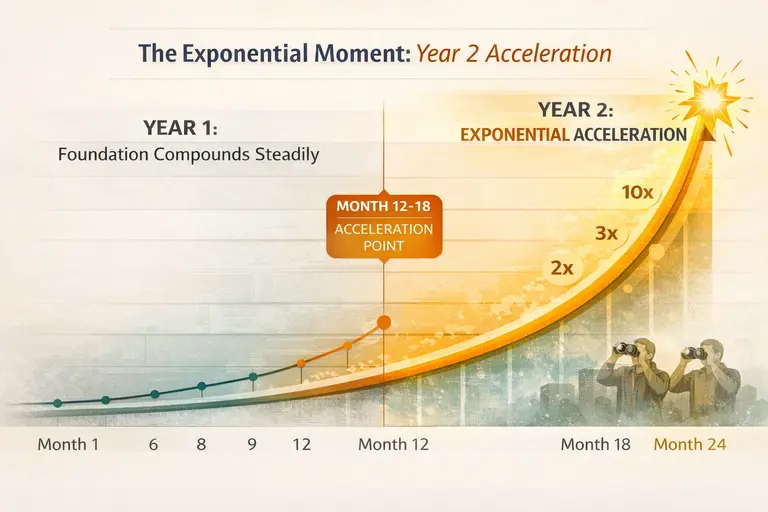
But Month 12 is just the halfway point of this timeline. The real compounding is about to accelerate.
As you move into Month 18 and beyond, what you’ve built in the first year becomes the foundation for exponential growth. Your voice is recognizable. Your market position is established. Your competitive advantage is real.
Now it compounds faster.
That’s what I want you to see when you look at the content operating system compounding benefits timeline: Month 1 is hard. But Month 12 proves it was worth it. And Month 24 proves that the payoff is just beginning.
Chris’s Reflection: The moment I’m watching for at Month 12 is when teams realize they can’t leave. Not because they’re forced. Because they understand what they’d be losing. Twelve months of accumulated consistency. Market position they built through commitment. That’s the compound effect taking hold.
Month 18 – 24: The Acceleration – Compounding Becomes Exponential
By Month 18, you’re seeing something you didn’t anticipate. The compound effect is accelerating.
Your voice isn’t just recognizable anymore. It’s your competitive moat. Competitors still trying to catch up can’t. Not because they lack resources. Because they haven’t committed to the timeline. Consistency takes time to compound.
Search visibility accelerates exponentially. Not linearly. Your best content continues to rank. New content ranks faster because Google already trusts your entity. Your voice is known.
Market position strengthens. Your audience isn’t just recognizing you. They’re defending you. They’re consistently recommending you. Trusting you because your consistency has proven you’re serious about what you claim.
By Month 24 – full Year 2 – something profound has shifted. The content operating system compounding benefits aren’t theoretical anymore. They’re your competitive reality. Research on content marketing shows that old pieces continue to drive traffic and leads long after publication. Year 2 is when this compounding truly accelerates – your Month 1 content that felt restrictive is now pulling market position.
Your voice is unmistakable. Your market position is established. Your team is operating in a system that compounds value automatically. No effort required to maintain consistency. The system enforces it.
This is what I meant when I said Month 1 was worth it. Month 24 proves it.
Chris’s Reflection: Year 2 is when I see teams understand they’ve built something they can’t replicate at a competitor. Not because they’re locked in. Because they’ve spent 24 months building consistency. That’s not replicable. That’s the ultimate compound benefit.
The Complete Timeline: Month 1 Through Month 24
Let me show you the full arc of what content operating system compounding benefits actually look like:
Months 1 – 3 (The Invisible Phase):
- Discomfort, adaptation, clarity
- Foundation building
- No visible market change yet
Months 6 – 12 (The Recognition Phase):
- Voice becomes recognizable
- Entity authority emerges
- Market position begins
Months 18 – 24 (The Acceleration Phase):
- Compound benefits become exponential
- Competitive moat solidifies
- Market position is undeniable
This is the timeline. This is what happens when you commit to consistency and let it compound.
FAQ: Your Questions About the Compounding Timeline
Q: What if we see results faster than this timeline?
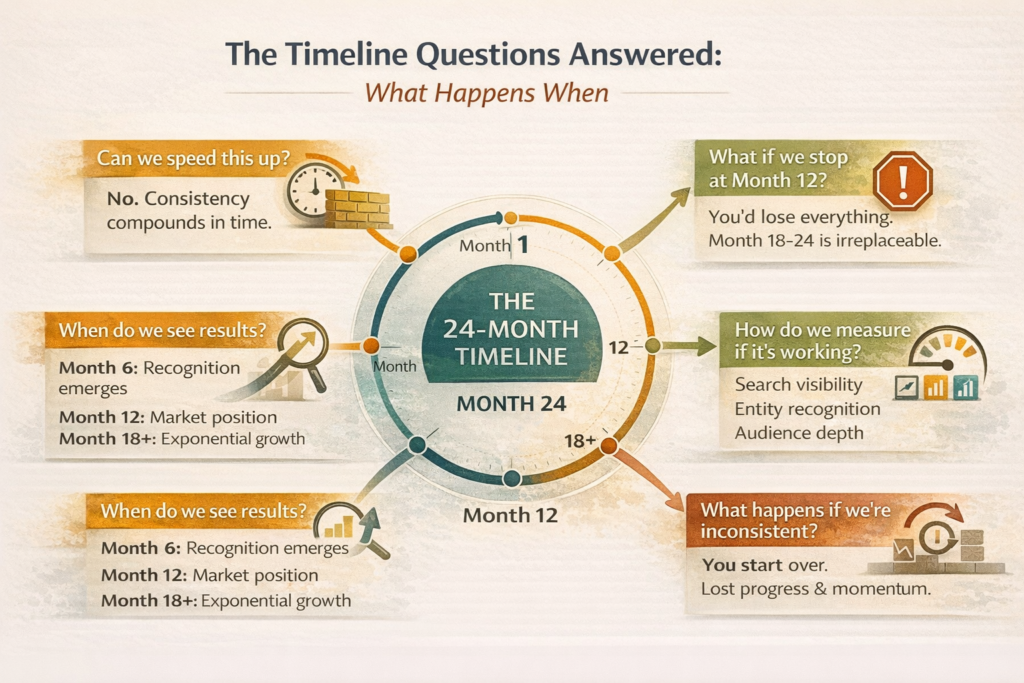
You might. Some organizations see recognition by Month 4 – 5 if they have strong existing audience. But the pattern I’m describing – where compound benefits become undeniable – follows this timeline reliably. Faster is possible. Slower is not.
Q: Does this timeline work for every content operating system?
The pattern is consistent across industries and company sizes. What changes is the specifics – how fast recognition emerges, how visibly entity authority shows up. But the arc (invisible → recognition → acceleration) is reliable.
Q: What happens if we stop being consistent after Month 12?
You’d lose everything you built. The compound effect only works if consistency persists. That’s why Month 12 is “can’t leave” – you understand what you’d lose. The content operating system compounding benefits disappear the moment consistency stops.
Q: Can we speed up the timeline?
Not really. Consistency compounds in time. You can’t buy your way to 24 months of compound benefits. You have to commit to the timeline and let it work.
Chris’s Reflection: I’ve seen organizations try to accelerate this timeline. It doesn’t work. What works is committing fully and letting consistency do its job. Patience is the only accelerator.
Q: How do we measure if compounding benefits are actually happening?
Track three metrics: search visibility (rankings and impressions), entity recognition (brand searches, branded traffic), and audience depth (repeat visitors, loyalty signals). These three tell the story of compounding.
Key Takeaways: What You Should Remember
1. Compounding Benefits Follow a Predictable Timeline Invisible in Months 1 – 3. Recognition in Months 6 – 12. Acceleration in Months 18 – 24. The content operating system compounding benefits don’t happen randomly – they follow a pattern.
2. Month 1 Discomfort Compounds Into Month 24 Advantage The hard part comes first. The payoff comes later. That’s how compound effects work. The teams that understand this stay committed.
3. Visibility Emerges at Month 6, Becomes Obvious at Month 12 You’ll know when it’s working. Your voice will be recognizable. Your market position will be visible. You won’t question whether you made the right choice.
4. Entity Authority Is the Real Compound Benefit Search ranking is measurable. But entity authority – being recognized by Google and your audience as a specific entity with consistent perspective – that’s the deeper benefit. That’s what drives long – term advantage.
5. Competitors Can’t Replicate This Timeline They’d have to commit to 24 months of consistency. Most won’t. That’s why your consistency becomes your moat. You did the work they won’t.
6. The Content Operating System Compounds Automatically You’re not pushing consistency. The system enforces it. The compound benefits are automatic once the infrastructure is in place. That’s the whole point.
7. Month 1 Is Worth It Because Month 24 Proves It Every team that makes this journey tells me the same thing at Month 12: “I get it now.” At Month 24, they tell me: “This is why we couldn’t stop.”
The Real Insight: Why Compounding Benefits Matter
Here’s what most organizations don’t understand: consistency is boring. Until it isn’t. Until Month 6, consistency feels like a constraint. Until Month 12, it feels like routine. Until Month 18, it feels like an obligation. Creators who commit to consistency report the same realization: small consistent acts build SEO, trust, and authority that eventually feel inevitable. Month 1 routine becomes Month 18 power, proving that consistency is boring until it compounds.
Until Month 6, consistency feels like a constraint. Until Month 12, it feels like routine. Until Month 18, it feels like an obligation.
But somewhere between Month 18 and 24, consistency becomes power. Your voice becomes your advantage. The thing you committed to becomes the thing competitors can’t replicate.
That’s when you understand the content operating system compounding benefits aren’t just about search rankings or market position. They’re about building something that lasts because it’s built on commitment over time.
What’s Next: Understanding the Complete Picture
You’ve now seen the complete timeline of content operating system compounding benefits: from Month 1 discomfort through Year 2 acceleration. You understand when recognition emerges. You see how advantageous compounds are.
But the timeline doesn’t exist in isolation. It’s the proof of something larger: how content operating systems work, what they actually govern, and why consistency creates competitive advantage.
Read the complete Content Operating System article to understand the full framework:
- What a content operating system is (infrastructure, not a tool)
- What it governs across your entire operation
- Why refusing exceptions is the only answer that works
- How consistency builds entity authority over time
This article showed you the timeline. The pillar article shows you the system.
Also explore:
- Why Style Guides Fail – Adam shows you the structural reason guides can’t create this compounding effect. Understand why the timeline requires a system, not documentation.
- What Governance Costs Actually Buy – Brad talks you through the investment you’re making in Month 1. Context for why the early discomfort is necessary.
CItations and References
Digital Hype – https://digitalhype.co.uk/compounding-content-engine/ Compounding Content Engine
Aprimo – https://www.aprimo.com/blog/what-is-content-operations What is Content Operations
Thunder Tech – https://www.thundertech.com/blog-news/the-compounding-power-of-content-marketing The Compounding Power of Content Marketing
Averi – https://www.averi.ai/how-to/building-sustainable-growth-loops-content-that-compounds Building Sustainable Growth Loops: Content That Compounds
LinkedIn – Robbins – https://www.linkedin.com/pulse/compound-effect-content-creation-how-consistency-builds-robbins-5tm0c Compound Effect in Content Creation: How Consistency Builds Authority
About The Author
Chris Kulbaba
Chris is a business AI and systems adaptation expert who helps organizations see what’s actually happening, not what they think is happening. His superpower is pattern recognition. He notices trends before they become obvious. He sees how systems compound over time. He understands the invisible work that precedes visible results.
Chris doesn’t tell you what to do. He shows you what’s actually happening, then helps you see the implications. His approach is observational, pattern-focused, and grounded in what he’s witnessed teams experience when they commit to consistency.
His background spans employment specialist roles, technical leadership, and organizational development. He’s worked with diverse teams facing barriers to progress—and he’s learned that the ones who succeed are the ones who see patterns clearly and commit to them fully.



hello world
hello world