
Chris Kulbaba
TL;DR: THE MONTH 1-3 REALITY
Month 1 of content system implementation feels like failure, yet it’s not. It’s the system working exactly as designed. Your team will be frustrated. Decisions will slow down. Rewrites will increase. Morale will dip. This is normal.
By Month 3, if you hold the line without making exceptions, decision speed increases, question types shift from “why can’t we?” to “how do we?”, rewrites decrease, and morale recovers.
The teams that abandon at Month 1.5 never see Month 3. The teams that push through Month 1 without wavering never go back. The difference between success and failure is whether you refuse exceptions when pressure arrives.
Omnipressence Guide to Team Friction, Adoption Patterns, and Why Discomfort Proves It’s Working
CONTENT SYSTEM IMPLEMENTATION – THE MONTH 1 REALITY (No Romance)
Month 1 of content system implementation feels like failure. It’s not. It’s the system working exactly as designed.
You’ve made the decision. You’ve evaluated the options. You’ve committed to a system. You’ve told your team, “We’re implementing this.” Now Month 1 arrives. Your team is frustrated. They’re testing boundaries. They’re asking “Can we just do this one thing differently?” They’re looking for flexibility that doesn’t exist. And they’re confused about why you’re being so rigid.
When you flip from a tool-based approach to a system-based approach, you’re not upgrading software. You’re changing the entire architecture of how decisions get made. This isn’t a technology change. It’s a structural change. And that shift in how human beings interact with rules and boundaries creates predictable resistance patterns.
This discomfort is not temporary. But it’s not permanent either. It’s the adjustment phase. If you want week-by-week implementation reality for Month 1, Averi’s guide shows the day-to-day rhythm of those first four weeks and how teams navigate the progression. And if you understand what’s happening beneath the surface friction, you can navigate it instead of panicking.
Here’s what I want to tell you before anything else: the teams that build something that lasts are the ones who push through Month 1 without wavering. The ones who second-guess themselves and start making exceptions in Month 2 are the ones who end up with a tool that feels like a system, and tools always fail.
The decision you make about holding the line in Month 1 determines everything that happens in Month 12. If you haven’t yet decided whether a system approach is right for you, Adam’s decision framework for evaluating governance models can help you choose. But assuming you’ve already committed, here’s what the first 90 days actually feels like..
READING ADOPTION RESISTANCE – SIGNALS THAT PREDICT CONTENT SYSTEM IMPLEMENTATION SUCCESS
Adoption resistance is a signal. But most teams misread it. This is critical because how you interpret resistance determines how you respond to it, and how you respond determines whether your implementation succeeds or fails.
When your team pushes back on the system, they’re not telling you the system is wrong. They’re telling you something about themselves and how they relate to boundaries. And if you know how to read the signal, you can use it to strengthen implementation instead of weakening it. If your team doesn’t fully understand what a content operating system actually is, the resistance will feel random instead of predictable. The foundational clarity helps you explain it to your team when pushback arrives.
There are three types of resistance. They look similar on the surface. But they mean completely different things and require completely different responses.
Type 1: Legitimate Friction. This is real. Your team is genuinely struggling with how the system works. They’re hitting actual obstacles. They’re confused about rules. They’re working harder, not smarter, because something about the system is genuinely inefficient. This resistance is information. Listen to it. Fix the inefficiencies. Clarify the rules.
How to recognize it: Specific problems (“When I try to X, the system does Y instead of Z”). Questions about mechanism, not pushback on the rule itself.
Chris’s Reflection: If someone says “the system is slowing me down,” listen. Don’t defend the system. Ask what’s actually slowing them. Sometimes the system is fine, but your training was incomplete. Sometimes the rule is ambiguous. Sometimes the enforcement mechanism is broken. Fix the actual problem.
Type 2: Adaptation Testing. Your team is testing whether the boundaries are real. They’re asking “Can we make an exception for this important client?” They’re pushing on the limits to see what gives. This is not a flaw in them. This is what people do when you change the rules. They test the new rules to understand them. This is normal human behavior during organizational change.
The testing serves a purpose. Your team is trying to understand the new constraints. They need to know: Are these rules firm, or are they negotiable? Are exceptions possible, or is this truly non-negotiable? How much flexibility is there?
How to recognize it: Requests framed as special cases. “Just this one.” “This is different.” “Could we make an exception?” Not questioning the rule itself, but testing whether it applies universally.
Chris’s Reflection: The moment you make an exception to adaptation testing is the moment your system becomes a tool. Hold the line. But explain why you’re holding it. “We’re not making exceptions because the consistency is what makes the system work. You’ll see why in Month 6.” This explains the mechanism, not just the rule.
Type 3: Leadership Testing. Your team is testing whether leadership actually believes in the system. This is usually a CEO or founder request. “Can we make this announcement slightly different? This is special.” Or a senior leader saying, “Just this once, I need something that sounds different.”
This is the most dangerous resistance because it comes with authority. Your team watches to see if leadership will bend. If leadership bends, the signal is clear: the rules apply until they don’t. The deciding factor is power, not principle. That signal cascades through the entire organization.
How to recognize it: Requests from authority figures, framed as business necessity rather than preference. Often includes time pressure. “We need this by tomorrow.” Tests whether leadership is exempt from the system.
Chris’s Reflection: When leadership tests the system, don’t fight the leader. Acknowledge the request. Then explain the structural cost, not the personal inconvenience. “If we make this exception, we’re signaling to the team that rules are negotiable when pressure is high. That’s when we need consistency most.” Make the leader part of the system’s defense, not an exception to it.
THE ADOPTION ARC (Month 1-3)
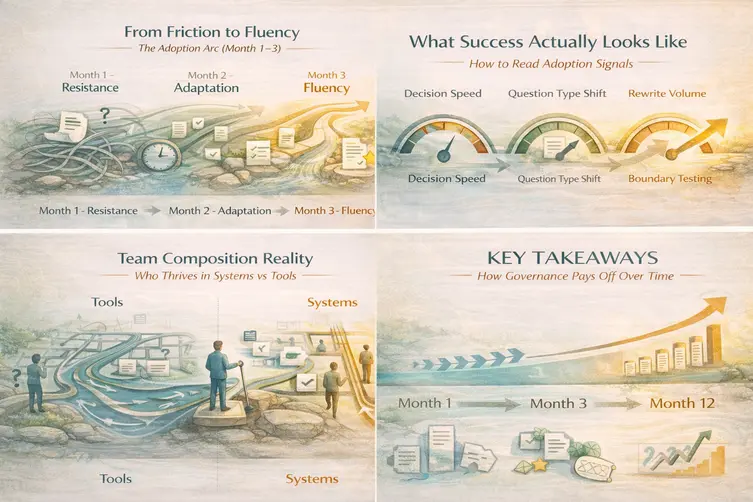
I’ve watched content system implementation follow a consistent arc across multiple organizations and team sizes. It’s not fast. It’s not linear. But it’s predictable. Understanding this arc helps you know when progress is happening, even when progress looks like failure.
Month 1: Resistance is high. The system feels external. People are testing boundaries constantly. Questions about voice interpretation increase. Rewrites increase. Decisions that should take 30 minutes take two hours because people are debating whether something fits the rules. The team is frustrated. You’re frustrated. Nobody is happy.
The implementation friction in Month 1 is real. This is the cost of architectural change. But understanding what’s creating the friction helps you navigate it instead of fighting it. You’re seeing more rewrites because the system won’t let inconsistency go live. This looks like failure. It’s actually working as designed. In a tool-based approach, that drift would be invisible until it’s embedded in 50+ pieces of content. In a system, it gets caught immediately. More visible problems early means fewer invisible problems later. If you need practical workflow structure for Month 1, Averi’s breakdown of content engine workflows for the first 30 days provides the operational foundation for how to execute during this friction phase.
Why the friction matters: Your team is experiencing cognitive load. They’re used to making decisions with flexibility as an option. Now flexibility is gone. Every decision requires them to fit their answer into the system’s constraints. This requires active thinking instead of passive habit. This extra cognitive work creates the sensation of slowdown. They’re correct that it’s slower in Month 1. This slowness is not a system flaw; it’s the cost of learning new decision-making patterns. Remember by it’s definition this is a content system implenetation – there are stages and steps you will go through, as with any system introduction it is unfamiliar until you achieve unconcious competence within it.
What to do: Don’t change the system. Don’t make exceptions. Don’t soften the rules. Instead, clarify them. If people keep asking the same question, the rule is ambiguous. Fix the rule’s clarity. If people keep hitting the same obstacle, the system has a genuine inefficiency. Fix the efficiency, not the rule.
Month 2: Something shifts. Your team stops testing the boundaries as aggressively. They’re starting to understand that the system won’t bend. Instead of asking “Can we do this differently?” they start asking “How do we do this right?” This is the critical moment. This question type shift is the signal that adoption is working. The implementation friction is decreasing because the team is adapting their thinking, not fighting the system.
Why this shift happens: Your team has moved from testing boundaries to accepting constraints. They’ve stopped asking “Is this rule real?” and started asking “How do I work within this rule?” This represents a fundamental psychological shift. They’ve internalized the constraint. It’s no longer external pressure; it’s now part of their mental model of how work gets done.
Questions decrease. Not because people understand everything. But because they’ve stopped expecting flexibility. They’ve started expecting consistency. The conversation changes from “what should we sound like?” to “is this how we sound?” Notice this shift. It’s the signal that the system is taking root.
Rewrites decrease. Not because writers are suddenly better. But because the system is catching drift at creation instead of at review. Writers are adjusting their approach before they hit the wall. They’re internalizing the rules and applying them proactively instead of reactively.
What to do: Notice this shift. Celebrate it quietly. Keep holding the line. Don’t interpret decreased resistance as “we can relax now.” Interpret it as “the system is taking root.” This is the moment to maintain consistency, not test flexibility.
Month 3: Resistance is nearly gone. Your team is fluent in the system. They’re not fighting it anymore. They’re using it. Decisions that took two hours in Month 1 take five minutes in Month 3. Not because people understand everything. Because the system has memory. Your team has built shared mental models of how decisions work.
By Month 3, the system isn’t an external constraint anymore. It’s the normal way of working. Your team has moved from “the system is forcing us to be consistent” to “the system makes consistency the default.” They can now operate within the system’s structure without constant conscious effort. It’s become habitual.
What’s happening underneath: Your team has progressed through a predictable adoption curve. Tuckman’s model of team development describes this: forming (Month 1, testing boundaries), storming (Month 2, testing each other’s commitment), norming (Month 3, establishing shared norms), and performing (Month 4+, working effectively together). The system implementation mirrors this pattern. Your team is normalizing the new way of working.
New writers onboard faster. They don’t have to learn from interpretation. They learn from the system. The pattern is obvious. The consistency is visible. Instead of observing five different interpretations, they see one clear model.
Decision speed increases significantly. Decisions that required discussion and review in Month 1 become automatic in Month 3. Not because decisions got easier. But because the system has memory. Your team doesn’t have to re-solve the same problem every time. They reference the system’s prior decisions.
What to do: This is the moment to reflect. Look back at what Month 1 felt like. Look at how Month 3 feels. The discomfort in Month 1 created the clarity in Month 3. This is where the compound effect begins to show. Async’s breakdown of the three-month content system implementation cycle (launch, stabilize, optimize) maps directly to what you’re experiencing. Use their framework to structure your rollout and help your team understand the progression.
Chris’s Reflection: Chris’s Reflection: The three-month arc is the most important period in content system implementation. Most teams abandon at Month 1.5 because they can’t see the payoff yet. The teams that make it to Month 3 never go back. They understand why the constraint was necessary. To see what happens Month 6-12 when you push through the Month 1-3 friction, check the detailed compounding timeline. That’s where the payoff becomes undeniable and explains why the Month 1 discomfort was necessary.
CONTENT SYSTEM IMPLEMENTATION – HOW TO READ ADOPTION SIGNALS
Here’s what success looks like during implementation. And here’s the critical part: it doesn’t look like success. It looks like you’re having more problems.
By adoption signals, I mean metrics that measure whether your team is learning and internalizing the system, not whether your content is reaching people or generating revenue. These are system adoption metrics, distinct from market metrics. They measure implementation health, not business health.
Signal 1: Decision Speed. How long does it take to make a content decision? In Month 1, this increases. Decisions take longer because people are debating the system and testing boundaries. This is correct. More time in Month 1 means the system is catching drift.
In Month 3, this decreases. Decisions take less time because the system has memory and clarity. Reference prior decisions. Apply established patterns. Less deliberation needed.
Track this: Create a simple log. Pick five common decision types (voice tone for a specific situation, how to handle a special audience, formatting exception, etc.). Time how long they take in Week 1 of Month 1. Time the same decisions in Week 4 of Month 3.
If decision speed is increasing in Month 2-3, the system is working. If it’s still slow in Month 3, you might have a clarity problem. If it’s decreasing in Month 1, you haven’t implemented the system. You’ve lightened the load.
Signal 2: Question Type Shift. What are people asking? In Month 1, questions reveal boundary testing. “Why do we have to do it this way?” “Can we make an exception?” “Doesn’t this limit our creativity?”
In Month 3, questions shift. “Is this the right way to do it?” “How does this fit the system?” “What’s the precedent for this situation?”
This shift from “why must I follow this?” to “how do I follow this correctly?” is the fundamental signal that adoption is working. It represents the psychological transition from resisting constraints to accepting them.
Why this matters: The question shift reveals internal acceptance. The team has moved from compliance (following rules reluctantly) to internalization (making rules part of their thinking). This is adoption.
Track this: Create a simple tally. In Month 1, count “why can’t we” questions vs. “how do we” questions. In Month 3, recount. The ratio should shift dramatically toward “how do we.”
Signal 3: Rewrite Volume. How many rewrites are happening? In Month 1, this increases. The system is catching drift that a tool would let through. This looks like increased problems. It’s actually increased prevention.
In Month 3, this should stabilize or decrease. Not because writers are perfect. But because the system is catching drift at creation instead of at review. Writers are catching their own drift before submitting.
Track this: Count rewrites per piece per month. Month 1 might show 2-3 rewrites per piece. Month 3 might show 0.5-1 rewrite per piece. The decrease signals that writers are internalizing the system’s rules.
Signal 4: Boundary Testing Frequency. How often are people asking for exceptions? In Month 1, this is high. “Can we do this differently for this client?” “Can we make an exception just this once?”
In Month 3, this should decrease. If exception requests are increasing in Month 3, you might have a clarity problem or you’ve signaled flexibility somewhere.
Track this: Count exception requests per month. Month 1 might have 8-10. Month 3 should have 2-3 or fewer. If the trend isn’t decreasing, something is wrong.
Signal 5: Team Morale Signals. This is harder to measure, but watch for it. In Month 1, morale dips. Frustration is high. This is normal. In Month 2, it stabilizes. In Month 3, it should improve as people see the payoff.
If morale is still declining in Month 3, something is wrong. Either the system has genuine problems, or leadership hasn’t held the line on exceptions, or something about the implementation is genuinely broken.
Track this: Monthly team check-in. One question: “On a scale of 1-10, how clear do you feel about how we work?” Month 1 might be 3-4. Month 3 should be 7-8. If scores aren’t improving, investigate.
Don’t measure market metrics in Month 1-3. Search rankings, traffic, audience growth. Those matter. But they’re lagging indicators. By the time market metrics show improvement, you’re in Month 6-9. If you wait for market metrics to validate the system, you’ll abandon it before you see results. School of Content provides a30-60-90 day implementation breakdown for content system implementation (orientation, analysis, decisions, action) that you can use as a diagnostic tool for whether you’re on track for each phase.
TEAM COMPOSITION REALITY DURING CONTENT SYSTEM IMPLEMENTATION
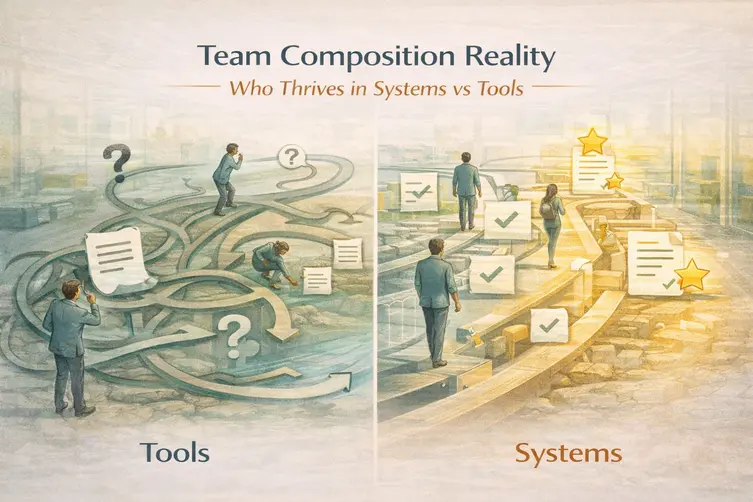
Here’s something nobody talks about: not everyone can make the transition from tools to systems.
Some people are wired for flexibility. They like having options. They like adapting in the moment. They like negotiating. Those people will struggle with system-based approaches. Not because they’re bad at their jobs. But because the architecture fundamentally doesn’t align with how they work.
You have three choices. You can push people through the friction. You can move them to different roles. Or you can accept that some percentage of your team will never be truly fluent in the system.
Pushing people through works sometimes. The people who struggle most in Month 1 often become your strongest advocates by Month 6. They’ve had to do the mental work to understand why the constraint exists. They’ve seen the payoff. They’ve moved from “this is terrible” to “this is how we work now.” And because they had to earn their understanding, they understand it better than people who adapted easily.
But it doesn’t always work. Some people will never accept the constraint. They’ll perform fine. But they’ll always be looking for workarounds. They’ll always be subtly pushing for exceptions. They’ll never fully embrace the system. And that’s okay. You can’t force adoption. But you do have to decide whether that person fits your team’s future.
The people who adapt easily aren’t necessarily the smartest people on your team. They’re the people who value consistency and clarity over flexibility and options. They see the constraint as liberation, not limitation. These people become system evangelists. They protect the system. They defend it when pressure arrives.
Identifying these people matters. They become your implementation allies.
Chris’s Reflection: Watch for the team members who stop complaining first. They’re not necessarily the ones who understand fastest. They’re often the ones who give up fastest and accept the system passively. The people who keep testing the boundaries in Month 2 and then suddenly get it in Month 3? Those are your system advocates. They earned their understanding.
There’s a hard conversation that happens in Month 3-4. You realize someone isn’t going to adapt. They’re competent. But they’re not system-compatible. The question becomes: do they stay in a role where they’re working around the system, or do they move to something else?
This conversation is harder than it should be. But it’s necessary. A system with system-incompatible people in it doesn’t work as designed. It becomes a tool again. And tools fail under pressure.
Team composition affects implementation success as much as the system itself. Choose wisely.
WHEN FRICTION SIGNALS FAILURE (Not Just Normal Progress)
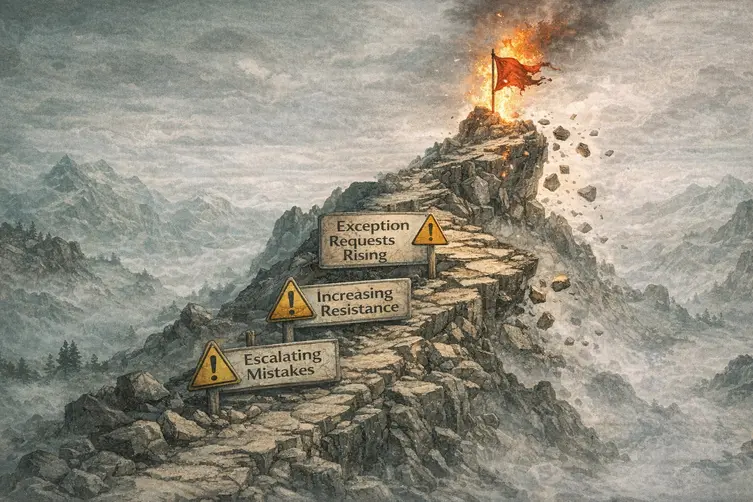
Here’s the hard question nobody asks in Month 1-3: What if the friction isn’t normal? What if the system implementation is genuinely failing?
There’s a difference between healthy friction (normal resistance during change) and structural failure (the system isn’t working or your team can’t adapt to it).
Red Flags That Signal Genuine Failure:
If you’re seeing these red flags and wondering whether a system approach actually works, it’s worth reviewing why style guides fail at consistency. Understanding that failure mechanism helps you diagnose whether your system implementation is broken or whether you chose the wrong approach entirely.
- Decision speed increases in Month 3 instead of decreasing. If decisions are getting slower instead of faster by Month 3, something is wrong. Either the system is genuinely inefficient, or your team has given up and is avoiding decisions.
- Question types don’t shift from “why can’t we” to “how do we.” If your team is still asking boundary questions in Month 3, they haven’t internalized the system. They’ve either accepted it passively or they’re still actively resisting.
- Rewrite volume increases every month instead of stabilizing. If rewrites keep going up, the system isn’t catching drift at creation. Either your rules are ambiguous or your enforcement mechanism is broken.
- Exception requests increase instead of decrease. If your team keeps pushing for exceptions in Month 3, they haven’t committed to the system. This suggests either the system is unsustainable or your leadership has signaled flexibility.
- Key team members have disengaged or left. If your strongest writers or leaders have abandoned the implementation in Month 2-3, something fundamental is wrong. You might have system-incompatible people in key roles.
- Team morale never recovers. Morale should dip in Month 1, stabilize in Month 2, improve in Month 3. If morale is still declining in Month 3, the implementation is causing harm, not progress.
When to Reconsider:
If you’re seeing three or more red flags in Month 3, you have a choice: fix the system or reconsider the content system implementation approach.
Fixing the system means: the rules are ambiguous or the enforcement is broken. You redesign the system’s clarity or mechanics. You don’t abandon the system approach; you fix the implementation.
Reconsidering the system approach means: your organization might not be ready for system-based governance. You might need to stay with a tool-based approach longer. This isn’t failure. It’s alignment. Some organizations can’t sustain systems. Acknowledging this is more honest than forcing an implementation that won’t work.
Chris’s Reflection: If you’re in Month 3 and seeing red flags, diagnose before you decide. Ask: Are we failing at implementing this system, or is this system not right for us? The answer determines your next move.
CONTENT SYSTEM IMPLEMENTATION – LEADERSHIP UNDER PRESSURE
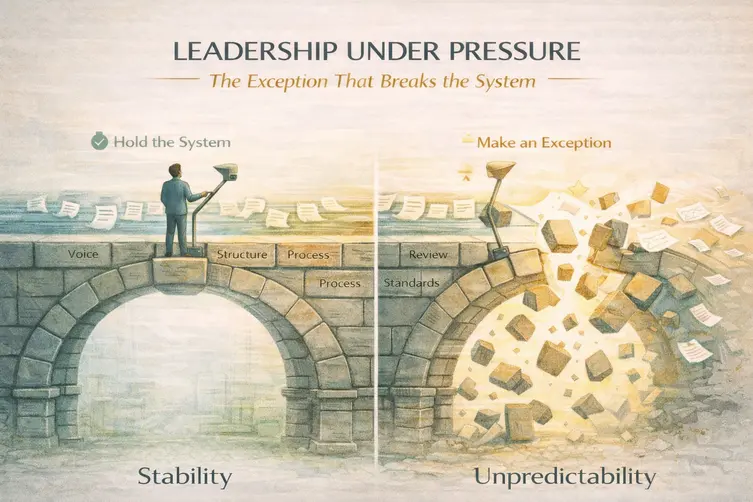
Here’s the moment that determines everything: Month 2 or early Month 3, someone in leadership asks for an exception.
It’s usually framed gently. “This campaign is special. Can we make this one piece sound slightly different?” Or it’s not framed gently. “I need this announcement to be different. Make it happen.”
This is the moment you find out if your leadership actually believes in the system or just thought it was a good idea.
If leadership says yes to the exception, you’re done. Your team watched. They learned that the rules apply until pressure arrives. Every exception after that is easier to justify. By Month 6, you don’t have a system. You have a tool with governance pretensions.
If leadership says no, you’re at the beginning of something real.
But saying no to leadership isn’t enough. You have to explain why you’re saying no. And the explanation has to land with the leader in a way that makes them part of the system’s defense, not exempted from it.
The conversation sounds like this: “I understand why this feels special. It is. But the system doesn’t work if special cases get exceptions. The consistency is what makes the system work. If we make an exception now, we signal to the team that the rules are flexible when pressure is high. That’s when we need consistency most. I need to say no. And I need you to understand why that’s the right decision.”
This conversation often happens with the CEO or founder. These are the people who built the company and are used to getting what they want. Telling them no is not popular. But it’s necessary. The moment you tell the leader that consistency applies to them too, the system becomes real.
What happens after you hold the line: your team notices. They see that leadership actually meant it. They see that the constraint applies even when pressure arrives. That’s the moment the system becomes real to them. Not a policy. Not a suggestion. A real structural enforcement that applies universally.
Chris’s Reflection: When leadership wants an exception, don’t fight. Listen. Acknowledge why they want it. Then explain the structural cost, not the personal inconvenience. Make the leader part of the system defense, not an exception to it. “Your commitment to this decision is what makes the system real to the team.”
CONTENT SYSTEM IMPLEMENTATION – ADOPTION SUCCESS VS. FAILURE: WHAT TO WATCH FOR
| Adoption Metric | Green Flag (Success Signal) | Red Flag (Failure Signal) |
| Decision Speed | Decreasing Month 1-3. Faster decisions as the system gains memory. | Still slow or increasing in Month 3. Team debating constantly. |
| Question Type Shift | Moving from “Why can’t we?” to “How do we?” by Month 2. | Questions remain “Why must we?” in Month 3. No internalization. |
| Rewrite Volume | Decreases Month 1-3. The system catches drift at creation. | Increases every month. The system isn’t preventing drift. |
| Exception Requests | Decreasing each month. Team stops testing boundaries. | Increasing or staying high. The team hasn’t committed. |
| Team Morale Trend | Dips Month 1, stabilizes Month 2, improves Month 3. | Still declining in Month 3. Implementation causing harm. |
| Key Team Retention | The implementation team stays engaged through Month 3. | Key writers or leaders leave or disengage by Month 2. |
This table shows what working looks like vs. what failure looks like. Use it monthly to assess whether you’re on track.
CONTENT SYSTEM IMPLEMENTATION – THE METRICS THAT PROVE IT’S WORKING
You need to know, in Month 1-3, whether the system is actually working. But you can’t measure it with the metrics you normally use.
Traffic and volume are vanity metrics. They don’t tell you whether the system is working. What they tell you is whether your content is reaching people. That’s different. In Month 1-3, reach might stay flat while the content system implementation is installing. That’s fine.
The metrics that actually matter are adoption metrics. These measure whether your team is learning and internalizing the system.
Metric 1: Decision Speed (covered in Section 3). How long does it take to make a content decision? Track this. If decision speed is increasing in Month 2-3, the system is working.
Metric 2: Question Type Shift (covered in Section 3). Are people asking “why can’t we” or “how do we”? Track the ratio. If it’s shifting toward “how do we,” adoption is working.
Metric 3: Rewrite Volume (covered in Section 3). How many rewrites are happening? Track this. If rewrites are going down in Month 3, the system is working.
Metric 4: Boundary Testing Reduction (covered in Section 3). How often are people asking for exceptions? Track this. If exception requests are decreasing, the system is working.
Metric 5: Team Morale (covered in Section 3). How clear does your team feel about how you work? Track this. If morale is improving in Month 3, the system is working.
Don’t measure market metrics in Month 1-3. Search rankings, traffic, audience growth. Those come in Month 6-9. The adoption metrics prove it’s working in Month 1-3. The market metrics prove it was worth it in Month 6-12.
By Month 1-3, your only question is: Is the team adopting the system? Not: Are we making money? Not: Is our reach growing? Just: Are our people internalizing how we work?
Chris’s Reflection: Create an adoption dashboard. Track decision speed, question types, rewrites, exception requests, and team sentiment. Show this to leadership monthly. Say, “Here’s what working looks like in Month 1-3. We’re on track.” This gives leadership confidence to hold the line when their question about an exception arrives.
CONNECTING TO YOUR CONTENT SYSTEM IMPLEMENTATION JOURNEY
This article assumes you’ve already made the decision to implement a content system. If you’re still evaluating whether a system is right for you, Adam’s decision framework (Spoke 4) will help you choose. If you’re concerned about what the system will cost your organization and your leadership, Brad’s cost-benefit analysis will prepare you for the Month 1 investment.
This implementation reality is what happens in the decision’s first 90 days. The payoff comes later. Chris’s compounding timeline shows what Month 6-12 looks like when you make it through Month 1-3 without abandoning.
And if you’re wondering what a content operating system actually is (and what it isn’t), the GENSEN inaugural article provides the foundational framework that all of this implementation is built on.
FAQ: YOUR CONTENT SYSTEM IMPLEMENTATION MONTH 1-3 QUESTIONS
Q: Will Month 1 really be this hard?
A: Yes. You’re changing how your organization makes decisions. That’s architectural change. It feels hard because it is hard. But the hardness is temporary. By Month 3, what felt hard in Month 1 feels normal.
Q: What if my team refuses to adapt?
A: Some people won’t adapt. That’s okay. Not everyone is system-compatible. By Month 3, you’ll know who your system advocates are (they tested the boundaries the hardest). You’ll also know who can’t make the transition (they disengaged). Decide whether those people fit your future.
Q: When should we make exceptions?
A: Never in Month 1-3. Making one exception sets precedent for five more. If you’re going to make exceptions, wait until Month 6+. But by then, you won’t want to. You’ll see why the system works.
Q: How do we know if we’re failing vs. just in normal friction?
A: Check the green flags vs. red flags table. If you’re seeing three or more red flags in Month 3, something is genuinely wrong. Either the system needs fixing or your organization isn’t ready for a system approach.
Q: What if our CEO wants an exception in Month 2?
A: Listen. Acknowledge why. Explain the structural cost. Don’t fight the CEO. Instead, make the CEO part of the system’s defense. “Your commitment to this decision is what makes it real to the team.”
Q: Should we measure results in Month 1-3?
A: Only adoption metrics. Decision speed, question types, rewrites, exception requests, team morale. Not market metrics. Search rankings, traffic, and reach come in Month 6-9. If you wait for market validation in Month 1-3, you’ll abandon before you see payoff.
Q: Is it normal for team morale to dip in Month 1?
A: Completely normal. Month 1: morale dips. Month 2: stabilizes. Month 3: improves. If morale is still declining in Month 3, something is wrong. Either the system is broken or leadership hasn’t held the line.
Q: How do we explain this to leadership?
A: Show them the adoption dashboard monthly. Say, “Here’s what working looks like in Month 1-3. We’re on track.” Give them concrete metrics. This gives them confidence to hold the line when the pressure arrives.
Q: What if we’re seeing red flags in Month 3?
A: Diagnose before you decide. Are you failing at implementing this system, or is this system not right for your organization? Those require different responses. Failing at implementation means fix the system. System not right for you means accept a tool approach instead.
Q: Can we speed up the Month 1-3 arc?
A: No. This isn’t about effort. It’s about organizational change taking time. Teams need three months to internalize constraints. You can’t compress that. You can only hold the line.
CONTENT SYSTEM IMPLEMENTATION – KEY TAKEAWAYS
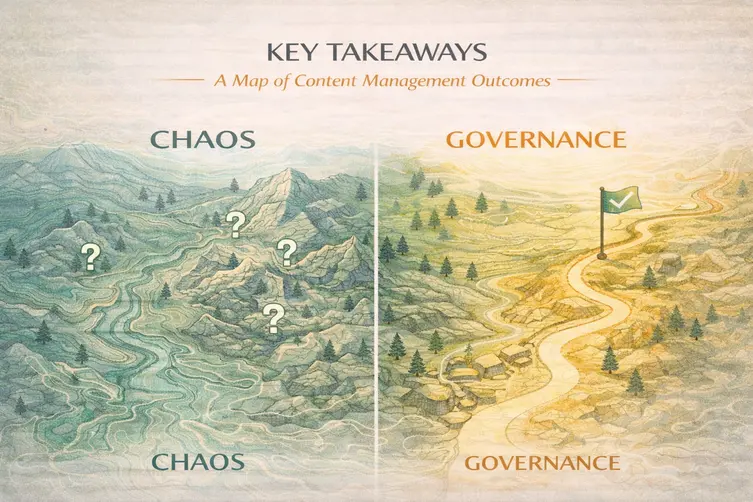
- Month 1-3 is the hardest and most important phase of implementation. Most teams abandon at Month 1.5. The teams that make it to Month 3 never go back.
- Resistance is a signal, not a failure. Three types of resistance require three different responses: legitimate friction gets fixed, adaptation testing gets held firm, leadership testing gets reframed as system defense.
- The adoption arc is predictable: Month 1 (high resistance, slow decisions), Month 2 (resistance decreases, question types shift), Month 3 (system becomes normal, decisions accelerate, morale recovers).
- Success in Month 1-3 doesn’t look like business success. It looks like adoption success. Track decision speed, question types, rewrite volume, exception requests, and team morale. Ignore market metrics until Month 6.
- The moment leadership makes an exception is the moment your system becomes a tool. Hold the line. But don’t fight the leader. Make them part of the system defense instead.
- Red flags in Month 3 signal genuine problems: decision speed increasing, question types not shifting, rewrites increasing, exceptions staying high, key people leaving, or morale still declining. These mean either fix the system or reconsider the system approach.
- Your commitment to holding the line in Month 1 determines everything that happens in Month 12. This is the most important decision you’ll make about content implementation.
RESEARCH & CITATIONS
This article is grounded in organizational change management, team development research, and real-world implementation patterns observed across multiple organizations.
Key frameworks referenced:
- Tuckman’s stages of team development (forming, storming, norming, performing) — explains the predictable progression teams experience during Month 1-3 implementation
- Organizational change management principles — foundation for understanding resistance patterns and adoption curves
- Team dynamics and behavioral science — explains psychological shifts from resisting constraints to internalizing them
Recommended external resources:
- Averi: How to Build a Content Engine That Doesn’t Burn Out Your Team — https://www.averi.ai/blog/how-to-build-a-content-engine-that-doesn-t-burn-out-your-team
- Async: The 90-Day Content Plan — https://async.com/blog/90-day-content-strategy/
- School of Content: The 30-60-90 Day Content Strategy — https://www.schoolofcontent.net/blog/30-60-90-day-plan-content-marketing-strategy
- Bruce W. Tuckman: Stages of Group Development — Original research on team development stages referenced in Section 2
Internal OmniPressence Resources:
- Why Your Brand Voice Keeps Drifting (Adam Spoke 1) — https://omnipressence.com/2026/03/05/content-operating-system-vs-style-guide/
- How to Evaluate Content Governance Models (Adam Spoke 4) — https://omnipressence.com/2026/03/09/how-to-evaluate-content-governance-models-tool-vs-system-vs-status-quo/
- Content Operating System Compounding Benefits Timeline (Chris Hub) — https://omnipressence.com/2026/03/05/content-operating-system-compounding-benefits-year-1-2-timeline/
- What You’re Building Without a Content Operating System (Brad Hub) — https://omnipressence.com/2026/03/05/governance-costs-what-ceos-give-up-for-brand-lock-in/
- Content Operating System: Not a Shortcut (GENSEN Hub) — https://omnipressence.com/2026/03/04/content-operating-system-not-shortcut/