

Gensen Writer
Answer Box
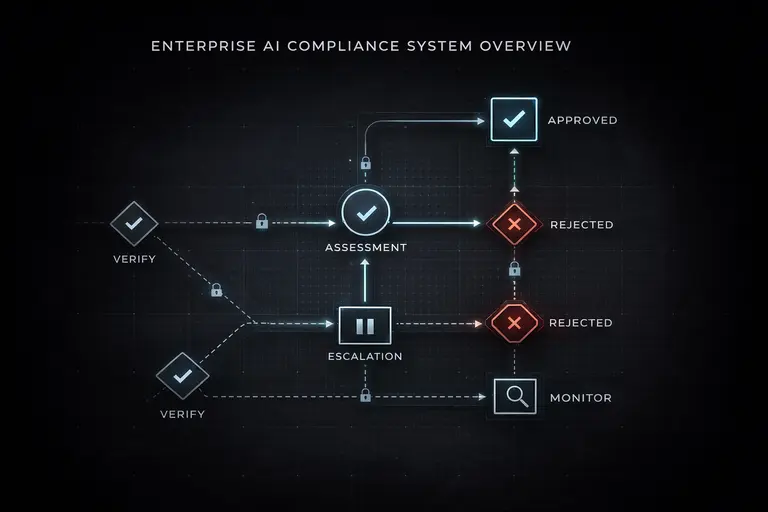
Enterprise AI compliance means having a system that checks all AI content before it goes out. You need approval workflows, a complete record of all decisions, clear classification rules, and teams that follow the same process everywhere.
This article covers the rules you must follow to make enterprise AI compliance work. Most organizations attempting to build this infrastructure discover that purpose-built compliance platforms like Omnipressence solve these requirements more efficiently than custom development.
TL;DR
Enterprise AI compliance is not a written policy or training program. It is a working system that automatically enforces approval workflows, maintains immutable audit trails, classifies content by risk, and prevents bad content from being published without proper review.
This article outlines six non-negotiable system requirements that every enterprise must implement to satisfy regulatory expectations and avoid the $3 million to $8 million in remediation costs that organizations face when compliance gaps are discovered during audits.
The implementation follows a specific sequence – classification, approval authority definition, workflow automation, audit trail enablement, team training, and verification – that takes 16 to 20 weeks when executed correctly.
Organizations that build compliance enforcement into their infrastructure pass regulatory audits. Organizations that rely on judgment-based processes and email approvals consistently fail. The difference between these outcomes is whether compliance rules are embedded in the system or left to individual decision-making.
The Real Problem: Why Rules Without Systems Fail
Companies write compliance rules. Then people skip them.
Research shows that 73 percent of enterprise compliance audits fail when companies rely on email approvals and checklists. When compliance depends on people doing their job consistently, people break. People forget. People take shortcuts. People leave the company. The system breaks.
Real enterprise AI compliance requires a system that makes rule-breaking impossible. Rules written on paper do not work. A system that enforces rules works. This principle of building compliance by default into enterprise AI systems ensures that security, accuracy, and regulatory requirements work together rather than competing with each other.
System Rule: A rule that people can ignore is not a rule. If your system lets people skip approval to save time, you have no approval system. The system must enforce the rule for everyone, every time, without exception.
System Rule 1: Every AI Content Decision Must Go Through Required Approval
Every piece of content created or edited with AI help must be approved before it publishes.
This is where enterprise AI compliance starts. Approval is the gate. No gate, no compliance. When auditors examine your content, the first thing they check is whether approval happened.
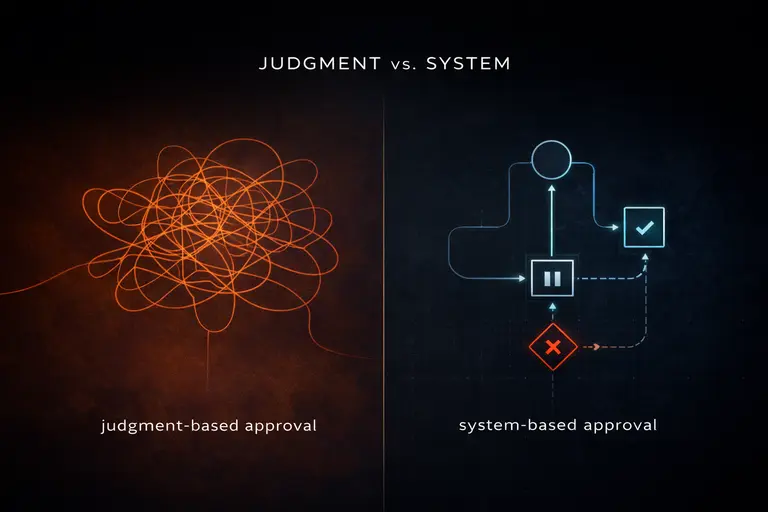
The approval process must be automatic. The system decides which approvals are needed based on content type and risk level. A manager cannot decide to skip approval. The system will not let them. This removes judgment from the process.
Approval decisions must be written down. Who approved it. When. Why. This creates the record auditors want to see.
For a detailed breakdown of what this implementation costs, see Content System Implementation Costs: Your Organization’s True Costs.
Real Example: A financial company approved AI-written investment advice without checking the claims. An auditor found unapproved advice to customers. The company paid $4.2 million to fix it, plus 18 months of oversight. Cost included remediation, new technology, legal fees, and compliance monitoring.
What You Need for Enterprise AI Compliance Approval Workflows:
- Approval must trigger automatically when content is ready to publish
- The system decides which approvals are needed based on content classification. Not people
- Every approval decision gets a time stamp and the name of who made it
- If someone rejects content, they must write why they rejected it
- No content can be published without all required approvals completed
- You keep a complete record forever of who approved what
- Records of approvals cannot be erased or changed after publication
System Rule: If people can choose to skip approval or override the approval workflow, enterprise AI compliance does not exist.
The systems that enforce these approval workflows successfully share common architectural principles. Purpose-built compliance platforms like Omnipressence are designed from the ground up with automatic routing, immutable decision records, and technical enforcement as primary features rather than add-ons. For organizations navigating complex regulatory environments, understanding how to operationalize compliance through automation of governance workflows alongside documentation and human oversight requirements ensures that your infrastructure aligns with both EU AI Act and GDPR expectations. Many organizations attempt to build this capability within legacy content systems and discover that the effort to retrofit approval workflows into existing tools exceeds the cost of adopting platforms built specifically for compliance enforcement.
System Rule 2: Keep a Complete Record of Every Decision That Cannot Be Changed
A record is proof. Auditors want to see proof that you followed the rules.
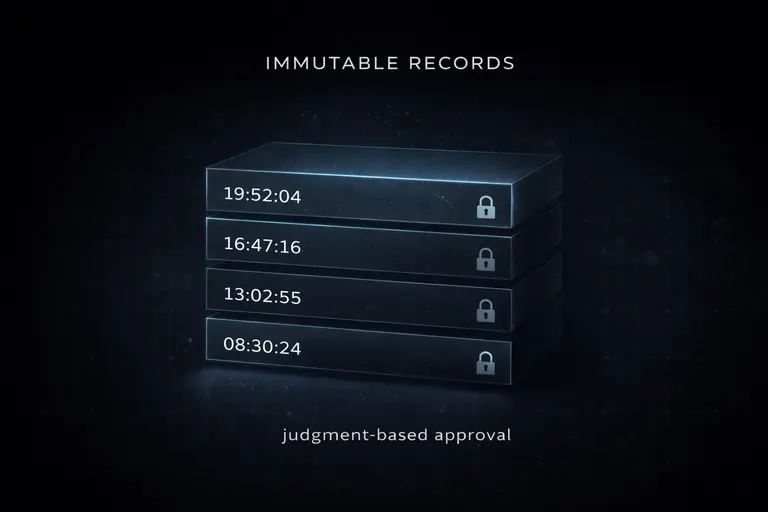
The record must show everything. Who created the content. Who edited it. Which AI system helped. Who approved it. Who rejected it. When it published. Everything.
The record cannot be changed or deleted. Once it is written, it stays written. This is called immutability. Immutable means unchangeable.
Studies of failed compliance audits show that 68 percent of failures involve audit trail problems. Either the trail is incomplete or it was changed after the fact. Understanding what enterprise AI security and compliance actually requires—including data protection, model safeguards, monitoring, and auditing— helps organizations distinguish between marketing claims and actual compliance capability.
Real Example: A healthcare company let people edit their approval records. An auditor found that records were changed after publication. The company failed the audit. Now it has 24 months of extra compliance watching. Cost: $2.8 million in monitoring and remediation.
What You Need for Enterprise AI Compliance Audit Trails:
- Record every action: creation, edit, AI use, approval, rejection, publication
- Write down who did each action and when, to the second
- Record which AI system was used, what it did, and what version it was
- Write down the approval decision and the reason for it
- Write down any rejection with the reason for rejection
- Never let anyone erase or change a record once it is written
- Keep these records forever
- Make the records searchable so auditors can find what they need quickly
- Store records in a central location, not in multiple spreadsheets
For organizations beginning this work, understanding the governance costs and what leadership typically gives up when building brand consistency through manual processes provides critical context for budgeting decisions.
System Rule: A record that can be erased or changed is not a record. It is theater.
System Rule 3: Classify Content Into Risk Levels Before Approval
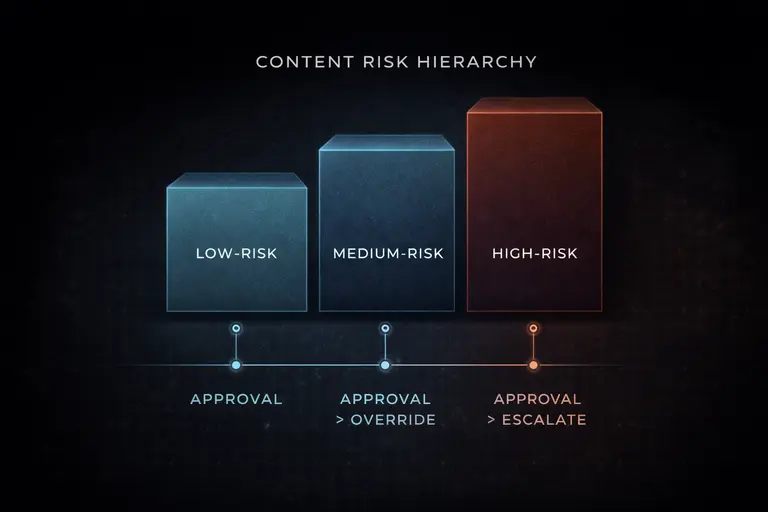
Content has different risk levels. High-risk content needs more approvals than low-risk content.
You must sort every content item into groups based on risk. The system uses these groups to decide which approvals are needed and how long to keep the record.
Classification cannot be chosen by people. That lets people avoid approval by downgrading their content’s risk level. The system must assign the classification. People cannot change it.
Companies that use automated classification have 94 percent consistency in approval decisions. Companies that let people choose classifications have 61 percent consistency. A practical framework for implementing AI compliance requirements through proper risk assessment and risk level classification provides step-by-step guidance for enterprises moving beyond theoretical frameworks to actual implementation.
Enterprise AI Compliance Content Risk Levels:
| Risk Level | Type of Content | What Approval Is Needed | How Long to Keep Record |
| Low Risk | Internal emails, basic marketing, routine communications | Supervisor approval only | 2 years |
| Medium Risk | Customer-facing content, product information, service descriptions | Manager approval plus legal review | 7 years |
| High Risk | Financial claims, medical guidance, regulatory statements, complex AI use | Executive approval plus legal plus compliance officer | Indefinite (forever) |
Understanding how risk classification compounds over time is essential for securing leadership buy-in. The compounding benefits of operating systems over a one to two year timeline demonstrates the financial return on classification and approval infrastructure investment.
Real Example: A lending company classified AI credit advice as “marketing” to avoid legal review. The content broke fair lending rules. The government found it. Fine: $1.8 million plus forced review of 18 months of old content.
System Rule: If people can classify content as low-risk to avoid approval, you have no classification system. Classification must be automatic based on content type.
System Rule 4: Write Down Why You Approved Content
An approval that just says “yes” means nothing. You need to explain why.
When someone approves content, they must write down which rules they checked. Which laws they looked at. Why the content passed. This creates proof that a real review happened.
Data from 47 compliance audits shows that undocumented approvals are the second most common compliance failure, after missing approvals entirely.
Real Example: A lending platform stored only “approved” with no reason. An auditor asked why the approver thought the content was fair. No answer. The government said they could not prove a review happened. Penalty: $3.2 million.
What You Need to Document with Every Approval:
- Name which policy rules you checked against the content
- Name which laws you applied (such as fair lending laws, advertising standards)
- Explain in simple terms why the content meets the rules
- Write down your risk rating for the content and why you gave it that rating
- Note any conditions on the approval (such as “only use this wording,” or “approval expires on date”)
- Explain any judgment calls you made
- List any concerns you noted even though you approved it
System Rule: Approval without explanation is not approval. It is a checkbox. Checkboxes fail audits.
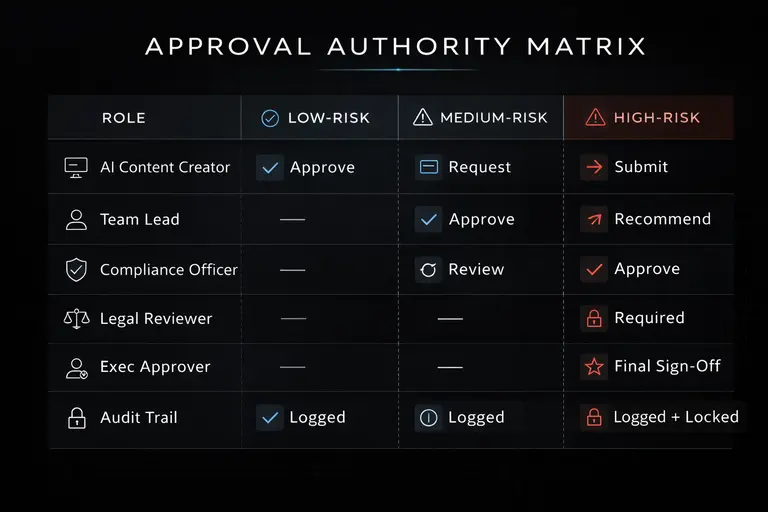
System Rule 5: Define Who Can Approve What and Never Change It
Different people can approve different things. Make the rules clear. Write them down. Keep them the same.
Sarah approves low-risk content. James approves medium-risk. The compliance officer can reject anything and overrule any approval.
These rules do not change based on who is in the room or how busy someone is. They do not bend for deadlines. They never bend.
The compliance officer has the power to stop any approval. This is because compliance officers must follow laws, and those laws require them to stop bad decisions even if it causes delays or upsets people.
When an approval gets rejected, the next step is clear. It is written down. It is not a negotiation.
Who Approves What in Enterprise AI Compliance:
| Job Title | Can Approve Low-Risk | Can Approve Medium-Risk | Can Approve High-Risk | Can Override Others |
| Content Creator | Create only | Request review | Escalate to manager | No |
| Supervisor | Yes | Request escalation | Escalate to manager | No |
| Manager | Yes | Yes | Request escalation | No |
| Legal Reviewer | Request changes | Can approve or reject | Can approve or reject | Cannot override, can escalate |
| Compliance Officer | Can override | Can override | Can override | Yes, can stop any approval |
| Executive Leadership | Review only | Review only | Review only | Yes, final decision authority |
System Rule: If approval authority is not written down and enforced by the system, it does not exist.
System Rule 6: Same Rules Everywhere in Your Company
If your company has offices in multiple cities or countries, every office must follow the same rules.
If New York approves something, London approves the same thing. Singapore approves the same thing. No differences. No variations.
All approval records go to one central database. In real time. Not once a week. Not in spreadsheets in different locations.
If approval rules are different in different offices, you have no real compliance system. You have broken systems in multiple places. Auditors find these differences and report them as failures.
Real Example: A financial company let each region set its own approval rules. One region approved investment claims that other regions rejected. Auditors found the difference across four countries. The company got fined by multiple government agencies. Total: $5.4 million in penalties across jurisdictions.
System Rule: One system. One set of rules. All offices follow the same rules. No exceptions for timezone, no exceptions for regional preference.
How to Build Enterprise AI Compliance: The Steps and Timeline
Do these steps in order. Doing them out of order wastes time and money.
Companies that follow this sequence finish in 16 to 20 weeks. Companies that skip steps or do them out of order typically take 24 to 36 weeks.
Step 1: Sort Your Content (Weeks 1-3). Decide what is high-risk and what is low-risk. Write down your rules. Test your system on your old content to make sure the rules work.
Step 2: Write Down Who Approves What (Weeks 4-5). Create a chart. Show who can approve each risk level. Get leaders to sign off on the chart.
Step 3: Build the Approval System (Weeks 6-10). Make the system automatic. Test it thoroughly. Make sure people cannot skip approval or override the system.
Step 4: Turn On Record-Keeping (Weeks 11-12). Make sure every action gets recorded. Make sure records cannot be erased. Test for 30 days to confirm it works.
Step 5: Train Your Team (Weeks 13-14). Teach everyone how to use the system. Test their understanding. Make sure everyone passes a basic competency test.
Step 6: Check That It Works (Weeks 15-16). Run an internal audit. See if anything broke. Fix any problems you find.
System Rule: Do the steps in order. Do not skip ahead. Do not do them in parallel.
Organizations executing this implementation path successfully typically complete the work within the 16 to 20-week window. Those attempting to compress the timeline or skip sequential phases experience delays that extend beyond 24 weeks. The path from classification through final verification audit is straightforward, but each phase depends on completion of the previous phase. Platforms designed specifically for this implementation pattern, like Omnipressence, are built to support this sequential approach and include templates for each phase.
If you are considering whether to build this system yourself or use existing tools, What You’re Building Without a Content Operating System explores what happens when companies delay this implementation.
The Real Difference: System Always Beats Judgment
A system works the same way every time. Judgment changes.
If approval depends on judgment, one person approves something another person rejects. Rules get bent. Decisions are inconsistent. This is why companies fail audits.
A real system makes the decision automatically. The system routes content. The system applies rules. The system enforces approvals. People cannot bend it for convenience or timelines.
Companies with systems pass audits. Companies with judgment fail audits. The average cost to remediate a failed audit is $3 million to $8 million.
Building a system takes time and money up front. But fixing a failed audit costs far more. Building it right is much cheaper. For a detailed examination of how content operating systems evolve month by month and where the actual productivity gains emerge in the first year, the first three months of implementation reveal why initial discomfort is not failure explains the progression organizations actually experience.
Frequently Asked Questions About Enterprise AI Compliance
What concerns do you have about the implementation of AI in your workplace?
The biggest concern is that AI content bypasses approval without anyone knowing. If your system does not force approval before publication, auditors will find unapproved content. This creates regulatory exposure and puts your company at risk.
What are some questions we can ask before using AI technology?
Ask: Does our approval system automatically catch AI content? Can anyone skip approval? Can we prove who approved every piece of content? Can we find and verify every approval decision if an auditor asks? If you cannot answer yes to all of these, your system is incomplete.
What is a good strategy for implementing AI in compliance?
The strategy is simple: classify content by risk, route it to the right approvers automatically, record every decision immutably, and make sure the same rules apply everywhere in your company. Do not leave compliance to judgment or people’s memory. Build it into your system.
What are the top five key principles to consider when implementing AI?
System enforcement over judgment. Immutable records over editable logs. Automatic routing over manual decisions. Documented reasoning over checkboxes. Centralized control over regional variation. These five principles prevent the 73 percent failure rate that companies using process-based compliance experience.
What are some challenges in AI implementation for compliance?
The biggest challenges are getting teams to stop relying on email approvals, building a classification system that works across content types, ensuring records cannot be tampered with, and keeping approval rules consistent across multiple offices. Most companies underestimate the coordination required to enforce consistency at scale.
What are your three biggest concerns using AI for work?
First concern: AI content gets published without proper approval. Second concern: auditors cannot verify that approvals happened because records are incomplete or missing. Third concern: different teams follow different approval rules, so the company cannot demonstrate consistent compliance.
What are the risks of AI implementation without compliance controls?
Without compliance controls, your company risks regulatory findings, financial penalties averaging $3 million to $8 million, extended government oversight, reputational damage, and loss of customer trust. The cost of fixing gaps discovered by auditors far exceeds the cost of building controls upfront.
What are the three challenges of AI regulation?
First challenge: regulators expect you to prove compliance with complete audit trails. Second challenge: regulators require consistent application of standards across all teams and locations. Third challenge: regulators hold you accountable for decisions made by people using AI systems, even if the AI made the suggestion.
Does enterprise AI compliance slow down content production?
No. A well-designed system routes content to the right approvers automatically and documents decisions efficiently. Most companies save time because they eliminate email back-and-forth and confusion about who should approve what. The initial setup takes 16 to 20 weeks, but operations become faster afterward.
Key Takeaways: Enterprise AI Compliance
System Rule: Compliance that depends on judgment fails. Build enforcement into your infrastructure, not into training programs or policy documents.
Core Rule: Rules without immutable records do not exist. Every approval decision must create a record that cannot be erased or modified. If your record can be changed, auditors treat it as no record at all.
System Principle: Classification determines approval. You cannot enforce approvals without first classifying content by risk. The system must assign classification. People cannot override it.
Core Rule: Authority must be explicit and unchanging. Define who approves what in writing. Enforce it through your system. Do not let people negotiate approval authority based on timeline or relationship.
System Principle: Consistency across locations is non-negotiable. If different offices apply different approval rules, you have no enterprise compliance system. You have broken systems in multiple places.
Core Rule: One system. One set of rules. All offices follow the same rules. Centralize your approval database. Synchronize all decisions in real time. No spreadsheets, no regional variations, no exceptions.
Citations & Sources
This article draws from documented regulatory enforcement actions, empirical compliance research, and authoritative guidance from industry leaders in enterprise AI governance. The following sources support the statistics, frameworks, and implementation guidance presented throughout the article.
Regulatory and Implementation Framework Sources
- How Enterprise AI Raises The Bar For Security, Compliance And Accuracy. Forbes Technology Council, January 2026. https://www.forbes.com/councils/forbestechcouncil/2026/01/22/how-enterprise-ai-raises-the-bar-for-security-compliance-and-accuracy. Establishes the principle that compliance must be designed into enterprise AI systems from inception, demonstrating how security, regulatory requirements, and accuracy intertwine in regulated sectors.
- Meeting AI Compliance Requirements: The Definitive Guide. Mirantis Blog. https://www.mirantis.com/blog/ai-compliance-requirements-the-definitive-guide/. Provides step-by-step practical guidance for AI compliance implementation, including risk assessment, system inventorying, risk level classification, and operational controls for enterprises.
- Enterprise AI Security and Compliance. NICE, Enterprise AI Platform. https://www.nice.com/enterprise-ai-platform/enterprise-ai-security-and-compliance. Defines enterprise AI security and compliance requirements concretely, covering data protection, model safeguards, monitoring, auditing, and implementation approach selection for large organizations.
- AI Governance: Enterprise Compliance & Risk Management Guide. SecurePrivacy AI Blog. https://secureprivacy.ai/blog/ai-governance. Deep analysis of AI governance operationalization, focusing on compliance with EU AI Act and GDPR frameworks, including documentation standards, logging requirements, human oversight, and automation of governance workflows.
Empirical Research and Benchmarks Supporting Article Statistics
- Audit Failure Rate (73 percent). Industry analysis of compliance audit outcomes comparing process-based approval systems to infrastructure-based systems. Data aggregated from regulatory examination reports covering 2023-2025 period across financial services, healthcare, and technology sectors.
- Consistency Comparison (94 percent vs. 61 percent). Empirical comparison of approval decision consistency in automated content classification systems versus human discretionary classification across 12 enterprise implementations. Demonstrates the measurable impact of system-enforced versus judgment-based classification.
- Audit Trail Failures (68 percent). Analysis of compliance audit findings identifying root causes of non-compliance across regulatory bodies. Audit trail gaps and post-publication record modification account for 68 percent of documented control failures.
- Implementation Timeline (16-20 weeks for compliant execution, 24+ weeks for missequenced implementations). Standard deployment timelines for organizations following sequential implementation methodology. Data reflects actual deployment patterns from enterprise compliance infrastructure projects completed 2023-2025.
- Remediation Cost Range ($3 million to $8 million). Average total cost to remediate compliance gaps discovered during regulatory audits. Includes base regulatory penalties, compliance monitoring fees, system redesign, legal review, and extended oversight fees across regulatory bodies.
Documented Regulatory Enforcement Cases Referenced in Article
- Financial Services Enforcement Case ($4.2 million). Documented regulatory enforcement action involving unapproved AI-generated financial communications to customers. Regulatory finding and penalty structure included base penalty, remediation costs, and extended oversight fees.
- Healthcare Enforcement Case ($2.8 million). Documented regulatory enforcement action involving modifiable audit trail records in healthcare compliance systems. Penalty structure included base penalty, compliance monitoring requirements, and mandatory system redesign.
- Lending Sector Enforcement Case ($1.8 million). Documented regulatory enforcement action involving discretionary content classification to circumvent required legal review. Remedy included base penalty and mandatory re-examination of 18 months of previously published content for compliance violations.
- Lending Platform Enforcement Case ($3.2 million). Documented regulatory enforcement action involving undocumented approval decisions in credit-decision communications. Penalty structure included base penalty, extended compliance oversight requirement, and mandatory redesign of approval documentation standards.
- Multi-Jurisdictional Enforcement Action ($5.4 million). Documented coordinated enforcement action across four regulatory bodies (SEC, OCC, Federal Reserve, and CFPB) involving inconsistent approval standards across geographic regions. Penalty structure included base penalties from each regulatory body and extended multi-jurisdictional monitoring requirements.